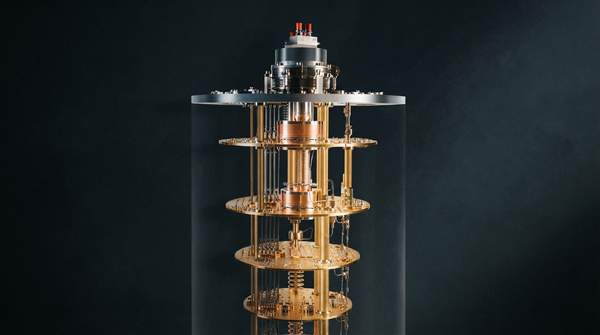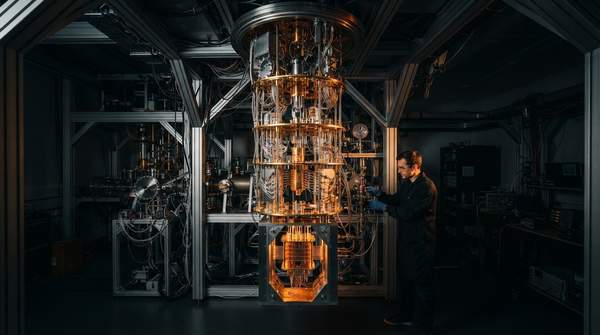
Superconducting quantum computers operate on principles that are only possible at temperatures colder than deep space, just fractions of a degree above absolute zero. Achieving this profound cold requires a specialized technology known as a dilution refrigerator, a complex, multi-stage system that leverages the unique quantum properties of helium isotopes. By carefully managing a cycle of pre-cooling, heat exchange, and a process analogous to evaporation, these machines create the stable, ultra-low-temperature environment essential for quantum bits, or qubits, to function without collapsing.
Dilution Refrigerator Cooling Stages
The journey to millikelvin temperatures inside a dilution refrigerator is not a single drop but a carefully orchestrated sequence of cooling stages. Each component plays a specific role in removing heat, culminating in the final, frigid environment where a quantum processor operates. The entire system relies on circulating a mixture of two helium isotopes, Helium-3 (³He) and Helium-4 (⁴He), through a closed loop that includes a pre-cooler, a still, heat exchangers, and a mixing chamber.
Stage 1: Pre-cooling with the Pulse Tube Cooler
The initial and most powerful cooling stage is handled by a pulse tube cryocooler. Described by AZoQuantum as the "workhorse for the first cooling stage," this device uses the compression and expansion of helium gas to reduce the temperature of the entire system. According to one technical paper, the working medium is first pre-cooled to below 4 Kelvin (-269.15°C). The best commercial pulse tube units can reach temperatures as low as 1 Kelvin. A key advantage of this technology is that it avoids mechanical moving parts at its cold tip, which minimizes the vibrations that could otherwise disrupt the delicate quantum states of the qubits.
Stage 2: The Still and Helium-3 Evaporation
After the initial pre-cooling, the helium isotope mixture enters a component called the still. Inside the still, the mixture is heated slightly, causing the more volatile Helium-3 to evaporate from the liquid mixture. According to a topic summary in Nature Index, this evaporation typically occurs at a temperature of around 0.7 Kelvin. This process serves a critical function: it creates a pressure difference that drives the Helium-3 gas upward and out of the dilution unit, allowing it to be collected, re-cooled, and recirculated back into the system. This continuous circulation is the engine of the entire refrigeration cycle.
Stage 3: Heat Exchangers for Efficient Cooling
As the now-gaseous Helium-3 is pumped away from the still, it is still extremely cold. To maximize efficiency, the refrigerator uses a series of heat exchangers. These components, which Bluefors notes can be spiral-shaped or step-like, are designed to transfer heat between the cold, outgoing Helium-3 and the warmer, incoming Helium-3 that is returning to the coldest part of the system. This pre-cools the incoming isotope before it reaches the final stage, significantly reducing the heat load on the mixing chamber. A report in Nature Index highlights that these heat exchangers are optimized for high thermal conductance and low mass to make this process as effective as possible.
Stage 4: The Mixing Chamber and Phase Separation
The final and most critical stage of cooling occurs in the mixing chamber. Here, the pre-cooled, liquid Helium-3 enters a bath of nearly pure Helium-4. At these extremely low temperatures (below about 0.8 Kelvin), the two isotopes do not fully mix. Instead, they undergo phase separation, forming a distinct boundary between a lighter, Helium-3-rich phase floating on top of a denser, Helium-4-rich phase. According to an explanation from Bluefors, the cooling effect is generated when Helium-3 atoms are pumped across this phase boundary, moving from the concentrated phase to the dilute phase. This process is thermodynamically similar to evaporation, as the atoms absorb energy to make the transition, actively drawing heat from the mixing chamber and anything connected to it, including the quantum processor.