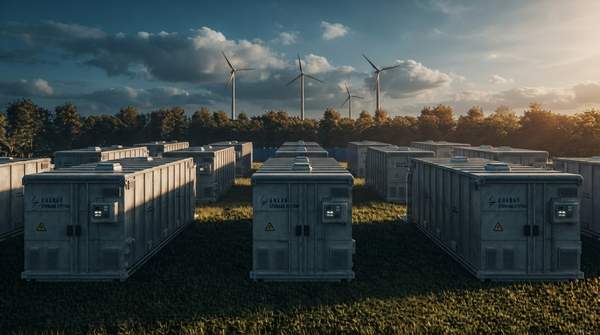
The short answer: lithium-ion batteries dominate grid-scale storage today because their high energy density, fast response and steeply falling costs make them the default for short-duration, high-power applications, while flow batteries—with cycle lives exceeding 10,000 cycles and inherently scalable liquid electrolytes—are the leading candidate for long-duration storage, provided their currently higher costs come down. The choice is less a contest than a division of labor, and the data gaps matter as much as the data itself.
Introduction to Grid-Scale Energy Storage
Why does storage become unavoidable at all? Because grids must match production to consumption, and variable renewable energy makes that balance harder. A widely cited rule of thumb holds that systems with under 40% variable renewables need only short-term storage; at 80%, medium-duration storage becomes essential, and beyond 90%, long-duration storage does too. That threshold logic explains why the debate between lithium-ion and flow batteries is really a debate about how deeply a grid has committed to wind and solar.
Two electrochemical families lead the field. Lithium-ion batteries, the incumbent, pack energy densely and respond in fractions of a second. Flow batteries, which store energy in liquid electrolytes, trade density for duration and durability. This comparison deliberately excludes mechanical options like pumped-hydro and compressed air, and its figures reflect data from roughly 2021 to 2026—a period of rapid change in both markets.