In the near-total darkness of the mesopelagic zone, light is not decoration—it is a survival tool with a small number of well-defined jobs. A 2025 study of mesopelagic fish by Chirag Balasubramanian and Farheen Raghavan, published in the International Journal of Biological Sciences, inferred ecological functions from photophore placement, emission wavelength, and flash kinetics, and found that predator avoidance through counterillumination was the most common role (38.2% of inferred functions), followed by prey attraction (24.7%) and species recognition (19.1%). All of these behaviors run on the same underlying chemistry: a reaction between a light-emitting molecule and an enzyme that produces a photon. Understanding that pairing of mechanism and function is what allows a biologist to look at a glowing animal and read its strategy.
The Chemical Spark: How Deep-Sea Organisms Create Light
Every bioluminescent organism makes light the same fundamental way: a light-emitting molecule called luciferin reacts with an enzyme called luciferase, and the product of that reaction is a photon of light. The Monterey Bay Aquarium's educational overview describes this as a chemical reaction in which luciferin and luciferase combine to release light, and it is the core pathway across bioluminescent life.
What varies is the chemistry. NOAA's Ocean Exploration fact sheet notes that although all bioluminescent organisms use a reaction between an enzyme and a substrate, different species use different chemicals in the process—evidence that the ability to make light may have evolved independently many times. That chemical diversity matters for deep-sea biology and for astrobiology alike: it suggests light production is a convergent solution to darkness rather than a single inherited trait.
Not every glowing animal runs the reaction itself. The aquarium's account notes that the anglerfish does not create its own light, instead relying on symbiotic algae housed inside its body to produce it. Whether the light comes from an animal's own luciferin or from a symbiotic partner, the output serves the same ecological ends. According to a study by MBARI cited by the aquarium, 75 percent of deep-sea animals make their own light.
Predator Avoidance: Disappearing in the Deep
The most common inferred function in mesopelagic fish is counterillumination, at 38.2% of the functions Balasubramanian and Raghavan identified. An organism using this strategy emits light from its underside to match the dim downwelling light from above, erasing its silhouette when seen from below. The study found that emission wavelengths clustered between 460 and 490 nanometers—blue light that matches the ambient deep-sea light window, which is exactly what a camouflage strategy requires.
Flash timing also reflects this defensive role. The researchers recorded flash durations ranging from 0.3 seconds in myctophids (lanternfishes) to over 8 seconds in stomiiforms, variation consistent with species-specific tuning of when and how long light is shown.
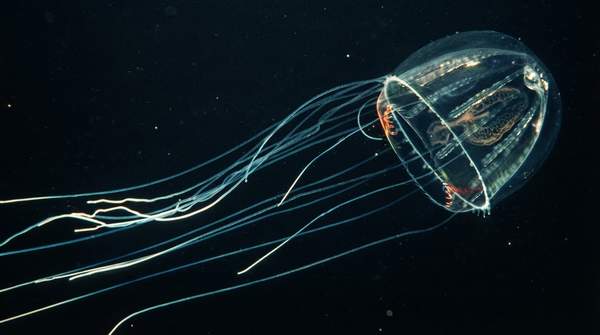
A second avoidance strategy is distraction. The Monterey Bay Aquarium describes a midwater jelly that can light up its long tentacles to distract a potential predator long enough to escape—and if that fails, it can detach its tentacles and flee. In the mesopelagic fish study, startling predators accounted for 7.3% of inferred functions. The shared logic is simple: a burst of unexpected light buys time.
Prey Attraction: Luring in the Darkness
Light can also draw food in. Prey attraction accounted for 24.7% of the inferred functions in mesopelagic fish, making it the second most common role. The anglerfish is the classic example of the lure strategy: rather than hunting in the dark, it carries a light source—produced, per the aquarium's account, by symbiotic algae housed inside its body—that draws curious prey within striking distance.
The study's method is worth noting, because it shows how such functions are established rather than assumed. Balasubramanian and Raghavan inferred ecological function from photophore placement, emission wavelength, and flash kinetics, after examining photophore morphology by histological sectioning and scanning electron microscopy, and analyzing luciferin-luciferase systems with spectrophotometric and mass spectrometric methods. A light organ positioned to illuminate the mouth region, paired with flash patterns suited to drawing attention, points to prey attraction; the same organ aimed downward points to camouflage.
Communication and Species Recognition: Signals in the Silence
The third major function is signaling to one's own kind. Species recognition accounted for 19.1% of inferred functions in the mesopelagic fish study, and intraspecific communication for a further 4.9%. In an environment where visual cues are otherwise nearly useless, species-specific light patterns and flash rhythms give animals a private channel for identifying mates and conspecifics.
The variation in flash duration the researchers documented—from a fraction of a second in myctophids to more than eight seconds in stomiiforms—illustrates how such signals can be species-specific. A receiver that recognizes the rhythm can distinguish a potential mate from a predator or an unrelated species in the dark.
Color can carry signal value too. The aquarium notes that while most animals in the sea make blue bioluminescent light, the gossamer worm (Tomopteris) is one of the few that makes yellow light, and MBARI researchers discovered the chemical responsible for that yellow coloration. Distinctive chemistry enables distinctive signals.
Deep-Sea Bioluminescence: Functions and Mechanisms
The table below classifies the primary ecological functions of deep-sea bioluminescence, quantifies their prevalence among the inferred functions in mesopelagic fish from the 2025 study, and links each to the underlying biochemistry. Use it to match an observed light organ or behavior to its most likely adaptive driver.
| Ecological Function | Strategy and Description | Prevalence in Mesopelagic Fish | Example Organism |
|---|---|---|---|
| Underlying mechanism | Luciferin (light-emitting molecule) reacts with luciferase (enzyme); the product is a photon. Specific chemicals vary by species, suggesting independent evolution. | Applies to all functions | Anglerfish (light from symbiotic algae housed inside its body) |
| Predator avoidance — counterillumination | Ventral light matches dim downwelling light, erasing the silhouette seen from below; emissions cluster at 460–490 nm, matching the ambient light window. | 38.2% of inferred functions | Myctophids (lanternfishes), with 0.3-second flashes |
| Predator avoidance — startling/distraction | A burst or cloud of light startles or distracts a predator long enough for escape. | 7.3% of inferred functions | Midwater jelly (lights up tentacles; can detach them and flee) |
| Prey attraction | Light organs lure curious prey within reach. | 24.7% of inferred functions | Anglerfish |
| Communication — species recognition | Species-specific patterns and flash rhythms identify conspecifics and mates. | 19.1% of inferred functions | Stomiiforms (flashes over 8 seconds) |
| Communication — intraspecific signaling | Light used within a species for signaling. | 4.9% of inferred functions | Gossamer worm (Tomopteris), one of few yellow-light emitters |
Two cautions apply when using this classification. First, the percentages describe inferred functions in mesopelagic fish specifically, not all deep-sea life, and the functions were inferred from photophore placement, emission wavelength, and flash kinetics rather than direct behavioral observation. Second, any given species may use its light for more than one purpose; the categories describe dominant roles, not exclusive ones. NOAA's fact sheet is blunt about the limits of current knowledge, noting that while bioluminescence may help organisms find food, reproduce, and defend themselves, "we don't really know the main purpose or function of bioluminescence."
Implications for Biodiversity and Astrobiology
Understanding the diverse and specific ecological roles of bioluminescence, driven by the adaptable luciferin-luciferase system, is essential for appreciating deep-sea biodiversity and considering potential light-based life forms in extraterrestrial environments. The evidence points in one consistent direction: bioluminescence in mesopelagic fishes is not a single adaptation but, in the words of Balasubramanian and Raghavan, "a diverse toolkit shaped by species-specific ecological pressures." The same reaction, built from different chemicals across independently evolved lineages, has been tuned into camouflage, lures, and signals.
For astrobiologists, the deep sea offers a working analogue: an environment where light production evolved repeatedly as a survival advantage in darkness. For marine biologists, the practical takeaway is a diagnostic habit—when you encounter a bioluminescent organism, read its photophore placement, emission wavelength, and flash kinetics against the three-function framework above. The measurable indicator of progress in this field is the continued discovery of new deep-sea species and their unique bioluminescent adaptations, each one a test of whether the classification holds.