At the Barnham site in Suffolk, UK, archaeologists have unearthed definitive evidence of early humans creating and controlling fire, pushing back the known date of this transformative technology by approximately 350,000 years. The definitive evidence of early humans creating and controlling fire, pushing back the known date of this transformative technology by approximately 350,000 years, reshapes our understanding of early hominin ingenuity, suggesting a mastery over one of nature's most powerful forces far earlier than once believed. The discovery invites a vivid imagining of ancient encampments, warmed by deliberate flames against the cold, providing not just heat but a focal point for communal life. These fires would have cast dancing shadows, creating a sense of security and fostering early forms of storytelling and social bonding among early hominins.
For a long time, the controlled use of fire was thought to be a relatively recent development in human history, but new evidence from the Barnham site indicates it was a consistent part of the hominin toolkit much earlier. The tension between old assumptions and new discoveries, fueled by new evidence from the Barnham site indicating fire was a consistent part of the hominin toolkit much earlier, prompts a re-examination of our ancestors' intelligence and adaptability. Previous theories, which placed the consistent adoption of fire much later, now face a direct challenge from these ancient hearths.
The timeline for significant cognitive and social advancements linked to fire, such as cooking and protection, likely needs to be re-evaluated, suggesting a more sophisticated early human ancestor than previously assumed. The re-evaluation of the timeline for significant cognitive and social advancements linked to fire, such as cooking and protection, forces archaeologists to reconsider the foundational stages of human technological and social evolution, hinting at a more complex story of early human innovation and the significant influence of controlled fire on early human evolution. It suggests that the path to modern human capabilities was paved with such early, ingenious adaptations.
The Groundbreaking Barnham Discovery
Archaeologists in Britain found evidence of deliberate fire-making dating to around 400,000 years ago at the Barnham site in Suffolk, according to AP News. The evidence of deliberate fire-making dating to around 400,000 years ago at the Barnham site in Suffolk places the earliest known instance of fire making by humans at a significantly earlier date than previously accepted. The Barnham site in Suffolk, UK, suggests fire-making is considerably earlier than previously thought, dating to more than 400 thousand years ago, reports Nature. These findings solidify the Barnham site as a pivotal location for understanding the true antiquity of human mastery over fire, moving beyond mere opportunistic use of natural blazes to active creation. It redefines the timeline for when human ancestors first harnessed this vital element.
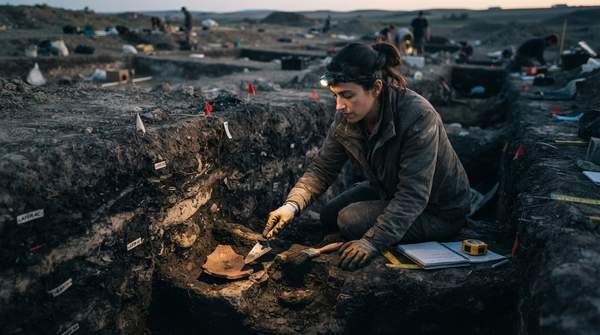
Before this discovery, many theories posited that hominins primarily harnessed fires started by lightning or volcanic activity, rather than initiating them. The clarity of the Barnham evidence, however, points to a purposeful and consistent engagement with fire, significantly altering the narrative of early human technological progress. The clarity of the Barnham evidence, pointing to a purposeful and consistent engagement with fire, offers a window into a period when human ancestors began to exert control over their environment in ways previously uncredited, profoundly changing their interaction with the natural world and their ability to adapt to diverse climates.
The implications extend to how we perceive the cognitive abilities of these early hominins. The systematic collection of fuel, the understanding of ignition principles, and the maintenance of a fire all require foresight and planning. These complex behaviors suggest a higher level of intelligence and social organization than earlier archaeological timelines often allowed, prompting a re-evaluation of the evolutionary path of human cognition. The sustained effort required for fire management points to a significant advancement in problem-solving and collaboration.
Scientific Evidence of Deliberate Control
Geochemical tests on heated clay at the Barnham site indicated temperatures of over 700°C with repeated fire-use in the same location, according to the Natural History Museum. Such intense and localized heat, sustained over time, points away from random natural fires and towards intentional management. The high temperature capability, indicated by geochemical tests on heated clay at the Barnham site showing temperatures of over 700°C with repeated fire-use, suggests fire was used for more than just warmth, potentially for cooking tough foods or hardening tool points, further expanding its utility. Furthermore, fragments of pyrite were found with these hearths of 400,000-year-old campfires. The combination of high temperatures, repeated use, and specific tools like pyrite provides compelling evidence that early hominins at Barnham possessed sophisticated fire-making skills, actively engineering its creation rather than simply exploiting existing flames.
The presence of pyrite, a mineral known for its ability to create sparks when struck against flint, directly suggests an ignition method. The presence of pyrite, directly suggesting an ignition method, transforms the understanding of fire use from passive gathering to active manufacturing, signifying a major leap in early technological development. It implies that these hominins understood the properties of different materials and could apply this knowledge to generate fire on demand, a technological leap with deep implications for survival and adaptation in challenging environments.
Such deliberate fire creation would have provided consistent warmth, protection from predators, and the ability to cook food. These advantages would have significantly improved survival rates and energy intake, fueling further cognitive development. The meticulous archaeological analysis, including microscopic examination of burnt remains and sediment layers, meticulously reconstructs these ancient scenes, revealing the sophisticated practices of our distant ancestors. This scientific rigor ensures the distinction between accidental burning and deliberate fire creation, providing confidence in the dating and interpretation of the Barnham hearths.
Fire's Transformative Role in Hominin Evolution
Fire became a fixed part of the human technological repertoire relatively recently, only about 400,000 years ago, states Universiteit Leiden. The timeline of fire becoming a fixed part of the human technological repertoire around 400,000 years ago aligns with other research indicating that from around 300,000 to 400,000 years ago onward, fire became a significant part of the hominin technological repertoire, as noted by the use of fire and human distribution - PMC. The earlier and more widespread integration of fire into daily life, as indicated by the 400,000-year timeline, suggests a deep influence on diet, protection, social structures, and ultimately, the evolutionary trajectory of early humans, making it a consistent technological advantage across different regions. It marks a period when fire transitioned from a rare environmental factor to an integrated element of hominin existence.
However, while Barnham shows evidence of fire making at 400,000 years ago, evidence of controlled fire use by hominins at Valdocarros II in Spain dates to 250,000 years ago, according to The Conversation. The evidence of controlled fire use by hominins at Valdocarros II in Spain dating to 250,000 years ago, compared to Barnham's 400,000-year-old fire making, implies a significant 150,000-year gap where hominins possessed the capability for fire creation before its widespread controlled use is broadly evidenced. The 150,000-year gap suggests either slow adoption across diverse geographical areas, or perhaps preservation biases in the archaeological record, where evidence of consistent use in some regions might simply be harder to find. It highlights the complexities of interpreting sparse archaeological data across vast geographical and temporal scales.
The ability to control fire would have expanded hominin habitats into colder climates, altered their diets through cooking, and extended daylight hours for tool-making and social interaction. Cooked food, for instance, is easier to digest, leading to greater nutrient absorption and potentially fueling the development of larger brains. Consistent access to fire, stemming from the ability to control it, would have fostered new social dynamics, with the hearth serving as a central gathering point, strengthening group cohesion and communication skills over generations, thereby accelerating cultural evolution.
Based on geochemical tests showing temperatures over 700°C and repeated fire-use in the same location at Barnham, early hominins were not just passive users of fire but active engineers, mastering a complex technology that profoundly changed their environment and survival strategies. The mastery of fire, demonstrating that early hominins were not just passive users but active engineers, speaks to a level of foresight and planning previously underestimated for this period in human history. The ability to generate fire at will signifies a cognitive leap, moving beyond reactive behavior to proactive manipulation of natural forces for specific benefits.
The Barnham evidence, pushing back definitive fire-making by approximately 350,000 years, demands a radical re-evaluation of hominin cognitive and technological capabilities. It proves that our ancestors were far more innovative and adaptable much earlier than conventional archaeological timelines suggest. The radical re-evaluation of hominin cognitive and technological capabilities, demanded by the Barnham evidence, extends to understanding the evolutionary pressures that might have favored such ingenuity, shaping the trajectory of human development and accelerating the development of cognitive capacities.
The Barnham evidence, pushing back definitive fire-making by approximately 350,000 years, changes how archaeologists interpret other sites from similar periods. If fire-making was a known skill, then the absence of evidence at other sites from similar periods might need re-evaluation.some sites might reflect preservation challenges rather than a lack of capability. It encourages a deeper look into subtle markers of fire use and ignition technologies, potentially uncovering more widespread evidence of this ancient skill. The implications for understanding early human diet, social structures, and even language development are substantial, as fire would have provided a stable platform for complex behaviors to emerge and flourish. This opens new avenues for research into the co-evolution of technology and human society.
New Research Methods and Unanswered Questions
What specific cognitive skills were required for early fire-making?
Early fire-making demanded several advanced cognitive skills, including foresight for fuel collection, an understanding of cause and effect for ignition, and sustained attention for maintenance. It also required problem-solving to adapt fire-making techniques to different materials and environments. These skills indicate a complex level of intelligence necessary for planning and executing multi-step tasks.
How do archaeologists distinguish between natural fires and controlled fires?
Archaeologists differentiate between natural and controlled fires by examining several indicators, such as the spatial distribution of burnt materials, the intensity and duration of heat (through geochemical analysis of heated sediments), and the presence of associated artifacts like hearth structures or tools for ignition. Controlled fires often show evidence of repeated use in the same location, consistent fuel management, and a lack of association with natural ignition sources like lightning strikes in the immediate vicinity.
Are there benefits of controlled burns for modern ecosystems?
While the focus of early human fire use was survival, modern controlled burns offer significant ecological benefits, including reducing wildfire risk by clearing underbrush, promoting the growth of fire-adapted plant species, and improving habitat for wildlife. These managed fires help maintain biodiversity and nutrient cycling in ecosystems that historically experienced natural fire regimes, demonstrating an ongoing human interaction with fire for land management.
The definitive evidence of deliberate fire-making at Barnham 400,000 years ago proves early hominins possessed advanced cognitive and technical skills, challenging the long-held view that such complex innovation emerged much later in human evolution. The mastery of fire was not a late-stage innovation but a foundational skill that empowered early humans to thrive and evolve, leaving a lasting legacy on their descendants. This evidence stands as a testament to their ingenuity hundreds of millennia ago, reshaping our understanding of the very beginnings of human technological prowess.
This discovery underscores the critical role archaeology plays in continually refining our understanding of human origins. Each new excavation, each meticulously analyzed artifact, can overturn long-standing assumptions and reveal a more intricate picture of our ancestors' lives. The persistent work of researchers across sites like Barnham continues to push the boundaries of what we thought possible for early hominins. These ongoing efforts ensure that our understanding of human history remains dynamic and responsive to new discoveries.
Continued excavations at Barnham and similar Paleolithic sites could yield further insights into the social structures and daily lives of these fire-making hominins. The ongoing research promises to deepen our appreciation for the significant influence controlled fire had on human evolution, revealing more about the earliest engineers who shaped our trajectory. This continuous archaeological exploration promises to illuminate further details of this ancient technological mastery.