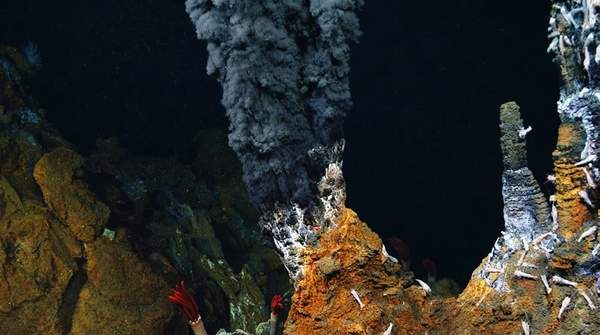
In the crushing pressure and absolute darkness of the deep ocean, entire ecosystems thrive around volcanic hot springs called hydrothermal vents. These environments, powered by Earth's internal heat rather than the sun, have not only redefined our understanding of life on this planet but have also become a primary model for how life might exist on other ocean worlds, such as Jupiter's moon Europa and Saturn's moon Enceladus.
Hydrothermal vents are geologically active areas on the seafloor where superheated, mineral-rich water erupts from the planet's crust. This process creates an oasis of chemical energy that supports a unique food web based on a process called chemosynthesis. For astrobiologists, this sunless system provides a compelling blueprint for searching for life in the hidden oceans of our solar system.
The Geological Engine of a Deep-Sea Vent
Hydrothermal vents are fundamentally a product of plate tectonics and volcanic activity. They are most commonly found along mid-ocean ridges, where tectonic plates are spreading apart and new ocean crust is formed from rising magma. According to the American Museum of Natural History, the process begins as cold seawater, driven by gravity, percolates down through cracks and fissures in the newly formed, cooling seafloor.
As the water descends deep into the crust, it is superheated by underlying magma chambers. This intense heat, which can reach temperatures of 400°C (750°F), prevents the water from boiling due to the immense pressure of the deep ocean. Instead, it becomes a highly reactive fluid that dissolves minerals and chemicals from the surrounding rock. This transformed, buoyant fluid then rises and is forcefully expelled from the seafloor, creating a vent.
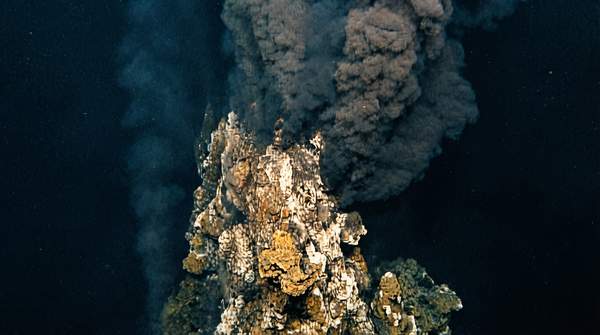
When this scorching, mineral-laden fluid mixes with the near-freezing ambient seawater, the dissolved minerals rapidly precipitate, or solidify. This creates the billowing clouds of dark particles that give some vents the name "black smokers." Over time, these mineral deposits build up around the vent opening, forming towering, chimney-like structures.
Chemosynthesis: Life's Chemical Energy Source
In the absence of sunlight, the foundation of life around hydrothermal vents is not photosynthesis but chemosynthesis. As explained by NASA, this process is carried out by specialized microbes, including bacteria and archaea, which are the primary producers in this ecosystem. Instead of using light energy to convert carbon dioxide into sugars, these organisms harness the chemical energy stored in the minerals spewing from the vents.
The vent fluid is rich in chemicals like hydrogen sulfide, which are toxic to most surface life but serve as a vital energy source for these microbes. Through chemosynthesis, they convert these inorganic chemicals into organic matter, forming the base of a complex food web. This microbial life, in turn, supports a diverse community of larger organisms, including giant tube worms, mussels, and shrimp, all adapted to the extreme pressure, temperature, and chemical conditions of the deep sea.