
Astrobiology
10 articles
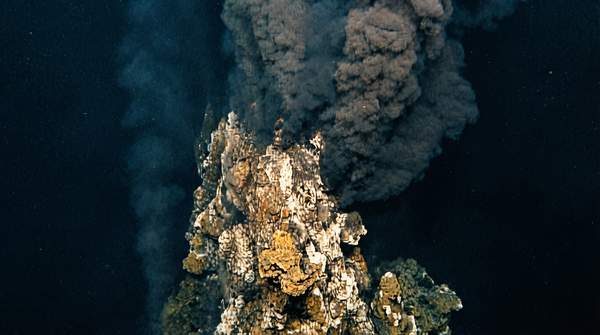
Chemical Clues to Alien Life: How Deep-Sea Vents Guide the Search
Deep-sea hydrothermal vents, powered by chemical energy, redefine our understanding of life's requirements and serve as primary models for astrobiologists. Studying their chemosynthesis pathways helps identify potential habitable environments on other planets and moons.
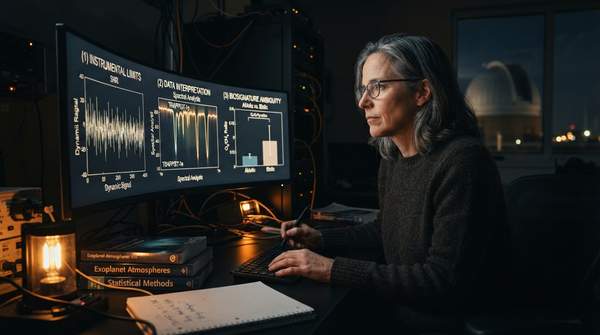
The Triple Challenge of Finding Life on Other Worlds
The search for life beyond Earth relies on detecting biosignatures in exoplanet atmospheres, a process fraught with immense difficulty. Scientists face three sequential hurdles: overcoming observational limits, accurately interpreting complex data, and definitively proving a biological origin over geological explanations.
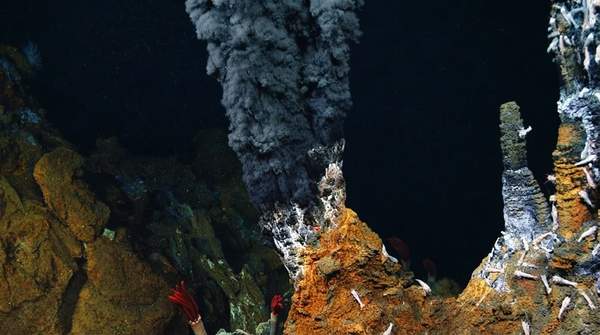
Deep-Sea Vents: A Blueprint for Life Beyond Earth
Deep-sea hydrothermal vents host unique ecosystems powered by Earth's internal heat and chemosynthesis, redefining our understanding of life. These sunless environments serve as a primary model for how life might exist on other ocean worlds and potentially where life on Earth began.

Astronomers Find Sugar Molecule in Deep Space, Hinting at Life's Origins
In the desolate expanse near our galaxy's supermassive black hole, astronomers have, for the first time, detected erythrulose, a four-carbon sugar molecule crucial to the very origins of life.

What is Deuterium in Comets and Early Solar System Formation?
The interstellar comet 3I/ATLAS carries water with a deuterium-to-hydrogen (D/H) ratio exceeding 6.

Study details Titan resources, compares them to Moon and Mars
A new NASA-supported study reveals Saturn's moon Titan, long considered an astrobiological curiosity, holds more readily usable resources for human settlement than the Moon or Mars.

NASA study finds phosphorus and nitrogen key for life origin
In a lab at NASA's Goddard Space Flight Center, scientists watched a chaotic soup of mixed RNA-DNA precursors spontaneously sort themselves into distinct, replicating strands.

NASA scientists discover how Earth gained life's essential elements
Scientists have confirmed hexamethylenetetramine (HMT), a key precursor to complex organic molecules, in three carbon-rich meteorites.

JWST Detects Methane in Atmosphere of Temperate Exoplanet TOI-199b
On a world the size of Saturn, bathed in a balmy 79 degrees Celsius, the James Webb Space Telescope has pierced the veil of exoplanet TOI-199b, pinpointing methane, a fundamental organic molecule.

Biological agents transform regolith, boosting crop fertility
Scientists recently grew 27 grams of duckweed from just one gram of cyanobacteria mixed with Martian regolith simulant.