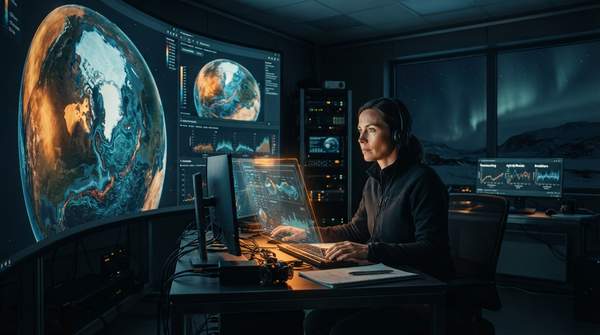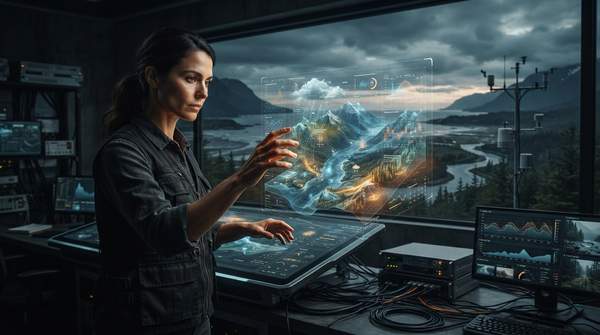
AI-powered digital twins are shifting environmental science from passive monitoring toward prediction: instead of simply recording what has already happened to a river, a city's air, or the global climate, researchers can build continuously updated virtual counterparts of real-world systems and use them to test interventions before making decisions in the physical world. A recent Perspective published in Artificial Intelligence & Environment argues that combining real-time observations, physical and data-driven models, AI algorithms, and decision feedback into a continuously evolving loop could let researchers anticipate risks and support adaptive management rather than merely document change.
The Multi-Layered Architecture of Environmental Digital Twins
At its core, a digital twin is deceptively simple: a physical object and a virtual model connected through bidirectional data flow. The information traveling from the physical component to the virtual model arrives in raw form and must be processed before it becomes useful, as a review of digital twin architecture in the journal literature on data exploration and implementation notes. What turns that simple pairing into an environmental forecasting engine is a stack of distinct layers, each with its own job.
The transformation is relatively recent. Early web-based digital twins, according to an EarthArXiv-hosted study of the technology's evolution, functioned primarily as static visualization tools: they democratized access to spatial data but lacked real-time synchronization and adaptive feedback. By the early 2010s, advances in IoT networks, wireless telemetry, and remote sensing enabled the shift to dynamic, data-driven platforms, with widespread sensor networks for precipitation, streamflow, and groundwater forming the synchronization backbone between physical and virtual domains.
On top of that sensing foundation sits the intelligence. Digital twins depend on the integration of numerous enabling technologies—the cyber-physical systems perspective from control engineering, IoT from networking, and machine learning and artificial intelligence from computational modeling. The result is a system closely linked with extensive modeling driven by advanced ML and deep learning alongside big-data analytics. A survey of digital twin AI frames the goal of this machinery as extracting insightful knowledge from simulations that can then be applied to enhance the real-world object, optimizing its efficiency and functionality. A familiar consumer analogue is a navigation app that fuses satellite imagery, GPS data, and live traffic into a constantly updated mirror of the physical world—a continuous feedback loop of sensing, modeling, and adaptation.
Deconstructing the Environmental Digital Twin: A Layered Model
The framework below breaks the abstract idea of an environmental digital twin into five functional layers, tracing how a real-world event—say, a storm swelling a watershed—becomes a prediction and a decision-support output. Follow a single data point down the stack: rainfall measured by a sensor is transmitted, cleaned and structured, reflected in the virtual model, and finally analyzed by AI to forecast flood risk and recommend an intervention.
| Layer | Function | Key technologies and processes |
|---|---|---|
| Physical System Layer | The tangible environmental entity being mirrored—the watershed, city, or atmosphere itself. | The real-world system whose state the twin virtually represents. |
| Sensing and Connectivity Layer | Collects real-time data from the physical environment and links it to the virtual model. | IoT networks, wireless telemetry, remote sensing; sensor networks for precipitation, streamflow, and groundwater. |
| Data Integration Layer | Processes raw environmental data into a usable format for the virtual model. | Collecting, processing, and structuring diverse datasets; big-data analytics. |
| Virtual Modeling Layer | Creates the virtual representation—geometry, structure, and logic mirroring the physical asset. | Computational modeling, often built from CAD or BIM source data; the core of the "twin." |
| Prediction and Feedback Layer | Generates insights, detects anomalies, predicts future states, and applies findings back to the real world. | Simulation, machine learning, and analytics; anomaly detection and what-if scenario testing. |
The decisive difference from traditional monitoring lies in the final layer. Conventional systems observe and report; a digital twin's analytics layer runs simulation and machine learning against the model and incoming data to detect anomalies, predict failures, and test what-if scenarios, then feeds the results back so the real-world system can be managed adaptively. The Perspective authors describe this as a continuously evolving loop connecting observations, models, algorithms, and decision feedback—allowing researchers to test possible futures before decisions are made in the physical world.
Key Applications in Environmental Science
The clearest working example is the European Union's Destination Earth initiative, whose Climate DT is being developed by the European Centre for Medium-Range Weather Forecasts. It provides multi-decadal global climate simulations with local granularity, including information tailored to the sectors most affected by climate change, such as renewable energy, urban planning, and hydrology. Its objective is to produce updated simulations every year or less, compared with current models that run only every several years, so the latest developments in Earth system science and digital infrastructure can be incorporated. A key innovation is a data-streaming concept that reduces the need to store massive volumes of kilometer-scale Earth system simulations spanning decades.
Extreme weather forecasting is a second major application. Peter Bauer, deputy director for research at ECMWF and co-initiator of Destination Earth, has said that for the project to succeed, Earth sciences need to be closely married to computer science development. His research team stated in Nature Computational Science that digital twin models would need to combine the broad set of physical processes of the Earth with small-scale events using AI and advanced algorithms to achieve higher-resolution models. The commercial sector is moving in the same direction: NVIDIA has announced plans for Earth-2, an AI supercomputer dedicated to climate change that would create a digital twin of the Earth, with the company stating that meter-scale resolution will be necessary to simulate clouds that reflect sunlight back to space.
Beyond climate, the Perspective points to applications in environmental instrument development and predictive digital toxicology, where virtual experimentation could help optimize monitoring technologies and connect environmental exposure with biological or health effects. Water management and wastewater treatment also appear among the fields where these systems are being explored.
Challenges and Considerations for Implementation
The computational bill is staggering. Bauer's team estimates that a digital twin of the Earth's scale would require a system with close to 20,000 GPUs. NVIDIA, for its part, has stated that the computing power demands for accurate climate modeling would be in the millions to billions of what is possible today. High-performance computing is not an optional accessory here; it is the precondition for processing vast data volumes and running complex simulations at the resolutions that make local predictions meaningful.
Human expertise is the second constraint. In high-risk settings such as nuclear safety, pollution emergencies, and extreme climate events, the Perspective argues that digital twins should support human experts rather than replace them. Oversight remains essential for interpreting results and making critical decisions where the stakes are measured in lives and ecosystems.
A third consideration is subtler: the environmental cost of the twin itself. A recent review in Sustainability proposes treating sustainability not only as an output of digital twin optimization but as a constraint on digital twin architecture, calling for intelligence budgeting, lifecycle-aware model design, and explicit treatment of rebound effects. Without those shifts, the review warns, AI-enabled digital twins risk becoming sophisticated instruments for displacing rather than reducing environmental impact—a possibility it says the literature has largely failed to confront.
Advancing Environmental Management with Digital Twins
For researchers and policymakers, the evidence points to a clear direction: prioritize investment in and development of multi-layered AI-powered environmental digital twin frameworks. The layered model shows why the investment must be systemic—sensing networks, data pipelines, virtual models, and AI analytics are only as strong as the weakest layer, and the feedback loop that distinguishes prediction from mere monitoring depends on all five working together. The measurable indicator of progress is increased integration of AI and digital twin technologies into national and international environmental monitoring and prediction programs, evidenced by new project announcements and collaborative initiatives—of which Destination Earth's Climate DT and its move toward annual, locally granular simulations are the leading published example.
Sources
- AI-enabled digital twins could shift environmental science from monitoring to prediction — EurekAlert!
- Digital twin: Data exploration, architecture, implementation and future - PMC
- Eartharxiv
- Digital Twin AI: Opportunities and Challenges from Large Language Models to World Models — ARXIV
- The Digital Twins — Destination Earth
- Digital Twins Help Tackle Climate Change Policy - ASME