Dendrochronology, the scientific study of tree rings, allows researchers to precisely date wooden objects and reconstruct environmental history by deciphering the stories encoded in annual growth layers. The method's power lies not in simply counting rings, but in a foundational technique called cross-dating. This process involves matching the unique patterns of wide and narrow rings across multiple trees from the same region. By aligning these distinctive sequences, scientists can assign an exact calendar year to every individual ring, creating a continuous timeline that can stretch back thousands of years and serve as a key to understanding the past.
The Principles Behind Tree-Ring Patterns
In most temperate regions, trees produce a single growth ring each year. The characteristics of this ring are a direct reflection of the environmental conditions during that growing season. Favorable years with ample moisture and ideal temperatures result in wide rings, while years of drought or stress produce narrow ones. According to the University of Arizona's Laboratory of Tree-Ring Research, this variability is essential; without a range of ring widths, cross-dating would be impossible. This "sensitivity" to climate creates a distinct, non-random pattern of rings over time, unique to a specific period and location, much like a historical barcode.
How Cross-Dating Builds a Master Chronology
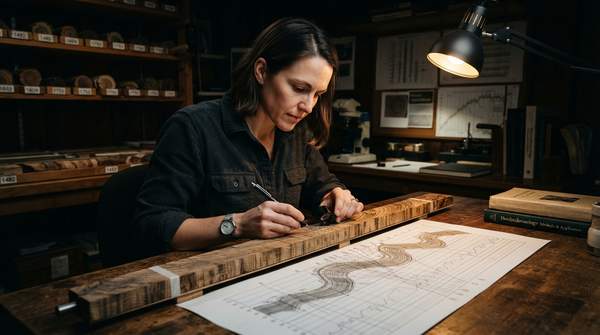
The core of dendrochronology is the meticulous process of building a master chronology for a specific region. This is achieved by overlapping tree-ring patterns from different sources, moving systematically from the present into the past. The technique, invented by A.E. Douglass, involves "matching patterns from one tree to another," as described in a Columbia University publication.
The process unfolds in sequential steps:
- Starting with the Present: Scientists begin by taking a core sample from a living, old tree. Since the outermost ring was formed in the current year of sampling, they can assign a precise calendar date to every ring by counting backward from the bark. This provides a securely dated, modern anchor for the chronology.
- Finding an Overlap in Time: The next step is to find older wood, such as a dead tree or a log from a historic structure. Researchers analyze its ring patterns and match the outer portion of its sequence to the inner, older portion of the living tree's sequence. This alignment bridges the gap between the two samples.
- Extending the Timeline Backward: Once a confident match is established, the rings from the older sample extend the known timeline further into the past. This process is repeated with progressively older wood, such as archaeological beams from ancient ruins. As one expert from the University of Arizona explains, if one core from a beam is already dated against a master chronology, it becomes straightforward to assign calendar dates to another core from the same site by matching their shared patterns of narrow rings.
- Creating the Master Chronology: By linking together dozens or even hundreds of overlapping samples, a continuous, year-by-year master tree-ring chronology is created for a geographic area. This reference tool can then be used to accurately date new wood samples of unknown age from that region.
Applications in Science and History
A precisely dated master chronology is a powerful tool with applications across numerous scientific disciplines. Because tree growth is an amalgam of environmental signals, these records provide invaluable data for understanding past events and long-term trends.
Reconstructing Past Climates
Climate scientists use tree-ring widths to reconstruct past environmental conditions, a field known as dendroclimatology. The National Park Service notes that variations in rings allow researchers to map historical climate, identifying periods of prolonged drought, unusual cold, or abundant rainfall long before human records were kept. This data is crucial for understanding long-term climate patterns and validating modern climate models.
Dating Archaeological Sites
For archaeologists, dendrochronology provides a way to establish precise dates for historical sites. By matching the ring patterns on wooden beams and artifacts from a site to the established master chronology, they can determine the exact year the trees were felled for construction. This method, sometimes called dendroarchaeology, has been instrumental in creating timelines for ancient settlements and understanding human behavior, such as how people sourced and used timber.
Studying Forest Ecology
Tree rings also offer a window into the history of forest ecosystems. Forest scientists apply dendrochronology to understand the age of a forest, its response to environmental change, and the history of natural disturbances. For example, scars within tree rings can pinpoint the exact years of past forest fires, and patterns of suppressed or released growth can reveal periods of insect outbreaks or competition among trees.
Calibrating Radiocarbon Dates
The absolute calendar dates provided by tree-ring chronologies serve a critical function in another major dating method: radiocarbon dating. Because the amount of carbon-14 in the atmosphere has fluctuated over time, raw radiocarbon dates must be calibrated to be accurate. The precisely dated wood from long tree-ring chronologies provides the benchmark needed to convert radiocarbon years into true calendar years, enhancing the accuracy of dating for a wide range of prehistoric materials.
Interpreting Tree-Ring Data for Environmental Insights
To accurately interpret tree-ring data, environmental scientists and students must master the principle of cross-dating to build precisely dated master chronologies. The scientific value of dendrochronology is not derived from a simple ring count but from the rigorous verification that cross-dating provides, ensuring that every ring is assigned its correct calendar year. The ability to correctly identify and match characteristic ring patterns across multiple samples, leading to the assignment of exact calendar dates for each ring in a chronology, is the fundamental skill that underpins all of the science's applications, from dating ancient ruins to forecasting future climate trends.
Sources
- Tree-Ring Services - Tree-Ring Dating — TREE RING
- Crossdating - The Basic Principle of Dendrochronology — LTRR
- Learning From Tree Rings: An Interview With Nicole Davi — State of the Planet
- Dendrochronology - Tonto National Monument (U.S. National Park Service) — NPS
- Dendrochronology: Tree Ring Dating & Climate Research — EnvironmentalScience.org - Environmental Science Education and Careers