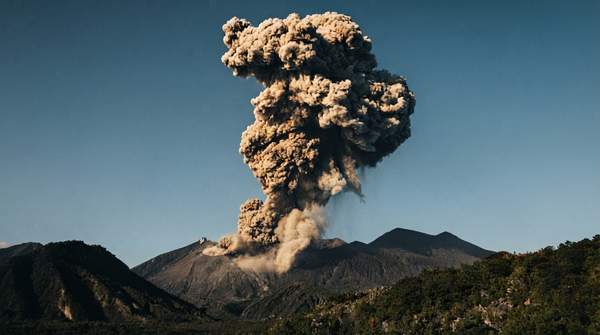
Large explosive eruptions cool the Earth, but not for the reason many people assume. The ash that dominates eruption images falls out of the atmosphere within days or weeks. The real climate lever is sulfur dioxide: when a powerful eruption injects it into the stratosphere, it converts into a planet-wide haze of sulfuric acid droplets that reflects sunlight for years. NASA's account of Mount Pinatubo, whose 1991 eruption injected about 15 million tons of sulfur dioxide into the stratosphere, describes exactly this chain: the gas reacted with water to form a hazy aerosol layer that strong stratospheric winds spread around the globe over two years. The result was measurable global cooling—roughly half a degree Celsius. Here is how the mechanism works, how two famous eruptions compare, and why volcanoes still do not drive long-term warming.
The Atmospheric Mechanism of Volcanic Cooling
The critical distinction is between the atmosphere's two lowest layers. The troposphere, which extends from the surface to roughly 10 kilometers, contains the rain clouds that wash out pollutants quickly. The stratosphere above it does not, as NASA's Earth Observatory explains. That difference determines everything: sulfur dioxide released into the troposphere is scrubbed out within days to weeks, while gas that punches through into the stratosphere persists for years.
This is why eruption height matters as much as eruption size. A plume must loft its sulfur high enough to cross the tropopause, the boundary between the two layers. University of Cambridge research on how warming will change volcanic effects notes that the tropopause is predicted to rise as the climate warms, making it harder for moderate eruptions to reach the stratosphere—under a high-end warming scenario, the cooling effect of yearly, moderate-sized events such as the 2011 Nabro eruption in Eritrea could be reduced by about 75 percent.
Once sulfur dioxide is in the stratosphere, the sequence unfolds in three steps. First, the gas reacts with water vapor to form sulfuric acid droplets—a haze of aerosol particles. Second, stratospheric winds disperse those particles across the globe over months to years. Third, the droplets scatter and reflect incoming solar radiation, reducing the energy reaching the lower atmosphere and surface. The USGS notes that this added atmospheric sulfur dioxide has occasionally caused detectable global cooling of the lower atmosphere in contemporary eruptions.
Sulfur Dioxide to Sulfate Aerosols: The Key Transformation
The chemistry is what turns a brief eruption into a multi-year climate event. Sulfur dioxide itself is a gas, and a plume's visible ash is largely irrelevant to global cooling. The transformation matters: SO₂ reacts with water in the stratosphere to form sulfuric acid droplets, the primary component of the volcanic aerosol layer that NASA documented after Pinatubo.
Because the stratosphere lacks rain clouds to wash out pollutants, the droplets linger. The USGS assessment of Pinatubo records that the eruption's aerosol veil produced a peak global midvisible optical depth of at least 0.1, with initial radiation losses of up to 5 percent for the first ten months. Optical depth is the measure to watch: it quantifies how much the aerosol layer intercepts sunlight, and it is the direct physical link between the eruption and the temperature drop that follows.
The consequences extend beyond temperature. The Royal Belgian Institute for Space Aeronomy reports that Pinatubo's cloud altered atmospheric dynamics and chemistry, including a decrease in the ozone layer of about 25 percent. The USGS likewise notes that a 15-to-20-megaton stratospheric SO₂ release can produce enough aerosols to offset present global warming trends and severely affect the ozone budget. The cooling, in other words, is the headline effect of a broader atmospheric perturbation.
Comparing Major Eruptions: Tambora (1815) and Pinatubo (1991)
Placing the two best-documented examples side by side shows how the size of the stratospheric sulfur injection scales the climate response. The figures for Tambora come from scientific estimates by Stothers (1984) and Mass and Portman (1989); Pinatubo's are drawn from NASA, USGS, NOAA and Belgian aeronomy sources.
| Eruption (Year) | Volcano | Estimated Sulfur Dioxide (SO₂) Injected into Stratosphere | Observed Peak Global Cooling |
|---|---|---|---|
| 1815 | Mount Tambora | 60–90 megatons (estimated, Stothers 1984) | 0.7–1.3°C global surface cooling in 1816 (estimated, Stothers 1984; Mass and Portman 1989) |
| 1991 | Mount Pinatubo | 15–20 megatons (NASA and USGS estimates) | 0.2–0.7°C global tropospheric cooling, with global surface cooling of perhaps in excess of 0.5°C in 1992 (NOAA; Royal Belgian Institute for Space Aeronomy) |
The juxtaposition is instructive. Tambora's stratospheric sulfur injection was roughly four times Pinatubo's, and the estimated cooling—up to about 1.3°C in the year after the eruption—was proportionally larger than Pinatubo's observed drop of roughly half a degree. The relationship is not perfectly precise, and the Tambora figures carry the uncertainty inherent in reconstructing a 19th-century event from indirect records. But the pattern holds: more sulfur in the stratosphere means a thicker aerosol veil, more reflected sunlight, and a deeper temperature dip.
Pinatubo remains the modern benchmark precisely because it was so well measured. The USGS notes that its aerosol measurements allowed validation of global circulation models and improved understanding of aerosol dispersal and decay. It also highlighted a puzzle: surface cooling is clearly documented after some eruptions, such as Gunung Agung in 1963, but not others, such as El Chichón in 1982—evidence that injection size is necessary but not the whole story.
Volcanic CO2 vs. Human Emissions: A Matter of Scale
If volcanoes can cool the planet with sulfur, can they warm it with carbon dioxide? The USGS answers directly: no. While sulfur dioxide from contemporary eruptions has occasionally caused detectable global cooling, the carbon dioxide released in contemporary volcanic eruptions has never caused detectable global warming of the atmosphere.
The reason is scale and persistence. NASA's climate FAQ puts the comparison in vivid terms: total annual CO₂ emissions from human activities are akin to one or more Yellowstone-sized super eruptions occurring every year—and such super eruptions actually happen only once every 100,000 to 200,000 years. Human CO₂ output greatly surpasses volcanic emissions, and unlike aerosols, which settle out within a few years, CO₂ persists in the atmosphere for decades to centuries.
Volcanic influence on climate is therefore real but bounded. May Chim, a PhD candidate in Cambridge's chemistry department and first author of a study on volcanic effects in climate projections, notes that compared with greenhouse gases emitted by human activity, "the effect that volcanoes have on the global climate is relatively minor," while stressing that eruptions still belong in climate models to accurately assess future temperature changes. Large, climate-significant eruptions happen only a handful of times per century; most eruptions are small and occur every year or two.
Two caveats frame the limits of this picture. This article covers the global cooling mechanism, not other volcanic hazards such as ashfall or lava flows, and not the complex secondary effects on regional weather patterns like El Niño. And the historical record rests on scientific estimates and observations, not firsthand accounts—especially for Tambora.
Understanding Volcanic Climate Influence
To accurately assess Earth's climate system, it is crucial to differentiate between the temporary, aerosol-driven cooling effects of large volcanic eruptions and the long-term warming trend driven by anthropogenic greenhouse gas emissions. Tambora and Pinatubo demonstrate that eruptions can shave a fraction of a degree to over a degree off global temperatures for a year or two; they do not alter the trajectory that human CO₂ sets over decades.
The measurable way to watch this distinction play out is to monitor the stratospheric aerosol optical depth and global mean surface temperature anomalies following major explosive volcanic eruptions, to observe the short-term cooling effect and its duration. Pinatubo set the template: an optical depth of at least 0.1, radiation losses up to 5 percent for ten months, and a temperature dip that faded as the aerosol veil settled out of the stratosphere.
Sources
- Global Effects of Mount Pinatubo - NASA Science
- Climate change will transform cooling effects of volcanic eruptions, study suggests — University of Cambridge
- Volcanoes Can Affect Climate — USGS
- Self — PUBS
- What do volcanoes have to do with climate change? - NASA Science
- Effect of volcanic eruptions significantly underestimated in climate projections — University of Cambridge