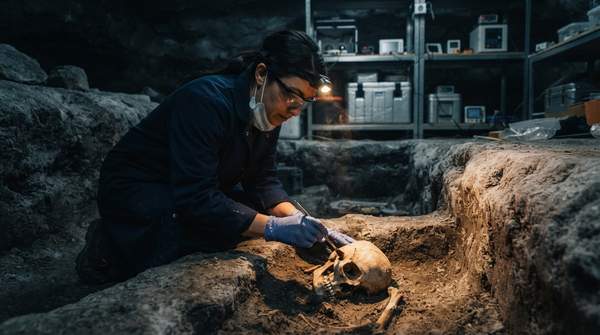
When archaeologists lift a bone from the ground, they are not just recovering an object—they are taking custody of a fragile molecular archive. Whether that archive still contains readable genetic material depends overwhelmingly on four conditions: the temperature and humidity of the burial environment, the acidity of the surrounding soil, and, crucially, the temperature and humidity of the room where the bone is stored afterward. Get all four right, and DNA that survived for centuries can still speak. Get the last one wrong, and a decade of careless shelving can undo what millennia of burial preserved.
Introduction to Ancient DNA Preservation
Obtaining sufficient amounts of high-quality ancient DNA from human skeletons remains a significant challenge in forensic and archaeological genetics, as a study on long-term skeletal storage published in Genes in 2025 makes clear. The difficulty is not simply age. DNA is a molecule that decays through chemical pathways that accelerate or slow depending on its surroundings, and the burial environment acts as a slow, continuous experiment on every skeleton in the ground.
A literature review of DNA preservation in human teeth, published in 2025, frames the problem usefully: the success of DNA extraction and analysis is influenced by multiple ante-mortem and post-mortem factors. Before death, tooth type, the biological age of the individual, and the presence of dental pathologies help determine the quantity and quality of recoverable DNA. After death, environmental conditions take over—exposure to humidity, temperature, and soil pH critically determine whether DNA is preserved or degraded.
What this means for the field archaeologist is that preservation potential is, to a meaningful degree, assessable before a single sample is drilled. A site's thermal regime, moisture, and soil chemistry are observable, comparable variables. This article focuses on skeletal remains—bone and teeth—and on the environmental and taphonomic factors that shape their genetic survival, not on laboratory extraction methods or the ethics of sampling human remains.