Ancient DNA analysis has done something archaeology and written sources could not: it has put a quantitative figure on one of early medieval Europe's most contested events. A large archaeogenetic study of medieval northwestern Europeans, published in Nature in 2022 by Gretzinger and colleagues, found that present-day English populations derive, on average, about a third of their ancestry from Anglo-Saxon migrants who crossed the North Sea during the Early Middle Ages. That single number transformed a centuries-old debate between "mass migration" and "elite takeover" into a question that genetic data could answer directly.
The Revolution of Ancient DNA in Historical Research
As a methodological review in Genome Biology puts it, ancient DNA has emerged as a powerful tool for studying human migration through the detection of admixture signatures—the genetic traces left when previously separated populations mix. Sequencing ancient genomes has, in the words of a Nature study on early medieval Europe led by Leo Speidel and Pontus Skoglund, revolutionized our ability to reconstruct expansions, migrations and admixture events in the distant past and understand their impact on human genetic variation today.
Yet the method's power has limits that matter for historical periods. Speidel and colleagues note that tracing history through genetic ancestry has remained challenging precisely for eras where the richest comparative information from history and archaeology exists, because ancestries in many regions are so similar as to be statistically indistinguishable with current approaches. Northern and central Europe since the start of the Iron Age around 500 BCE is one such region, with long-standing questions about large-scale migration during the fourth to sixth centuries CE and later Viking Age mobility. Their answer was a new approach, "time-stratified ancestry analysis," which uses inferred genome-wide genealogies to boost the statistical power of f-statistics several-fold.
The Ancient DNA Analysis Pipeline: From Sample to Historical Insight
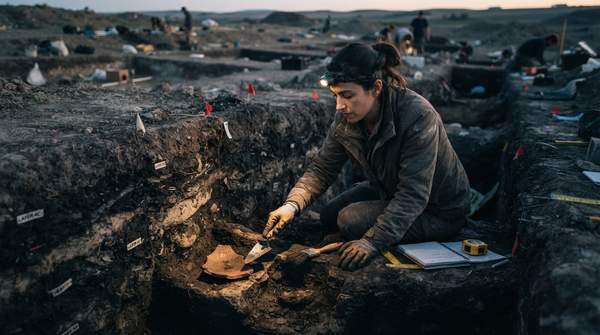
The journey from an excavated bone to a claim about medieval migration follows a strict sequence, and each stage transforms the evidence in a distinct way. The reader can trace it below, from field to final interpretation.
| Stage | What happens | Key controls and challenges |
|---|---|---|
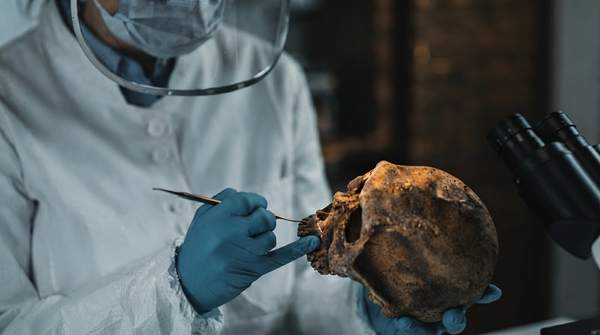
| 1. Sample selection and preparation | DNA is extracted from ancient bones and teeth using specialized protocols designed for highly degraded material, reducing microbial and human contamination and improving access to the endogenous DNA preserved in the specimen. | Modern contamination is the central threat; specialized extraction protocols exist specifically to address it. |
| 2. Contamination estimation | Each sample is screened before analysis. The Anglo-Saxon study used the ANGSD package to test heterozygosity on the X chromosome in male individuals, and Schmutzi or contamMix to estimate contamination from mitochondrial DNA. | A contamination threshold of 5% was applied; samples exceeding it are excluded. |
| 3. Sequencing and data processing | Ancient genomes are sequenced, aligned to a reference sequence, and filtered for quality. Duplicates and close relatives are removed, retaining the highest-coverage individual in each family clade. | Genomes with average autosomal coverage above 0.5× are generally considered reliable for imputation; the early medieval Europe study applied this cut-off in assembling a dataset of 1,556 ancient genomes. |
| 4. Statistical inference | Population-genomic methods, principally f-statistics and qpAdm, are used to reconstruct expansions, migrations and admixture events from the processed data. | Ancestries in many regions are statistically similar; boosting power, as with time-stratified ancestry analysis, may be needed. |
| 5. Historical interpretation | Genetic findings are synthesized with archaeology and history to describe past demographic events. | Genetics measures idealized theoretical populations while archaeology tracks individual movement—a fundamental synthesis challenge. |
The critical transformations happen at the boundaries: contamination control converts a fragile, degraded sample into trustworthy data, and statistical inference converts that data into proportions of ancestry attributable to specific source populations.