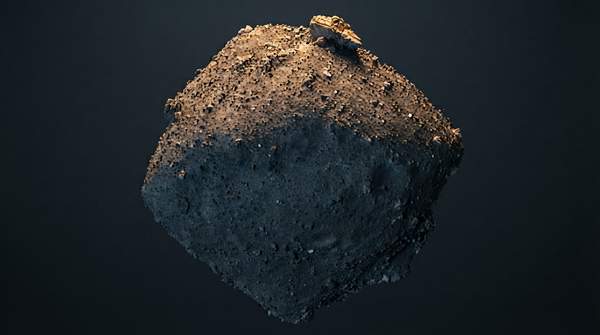
Japanese researchers have identified the complete set of five canonical nucleobases—adenine, guanine, cytosine, thymine and uracil—in pristine material returned from the asteroid Ryugu, providing the strongest evidence yet that the full genetic alphabet of DNA and RNA existed in space before life emerged on Earth. The finding, published in Nature Astronomy on 3 November 2026 by a team led by Toshiki Koga and Yasuhiro Oba, goes further than earlier discoveries: the nucleobases occur in nearly equal amounts of purines and pyrimidines, a chemical signature that distinguishes Ryugu from the Murchison, Bennu and Orgueil samples and points to diverse formation environments across the early Solar System.
Cosmic Building Blocks: Ryugu Asteroid Yields All Five Genetic Letters
The nucleobases are the molecular "letters" that spell out genetic information in every living thing on Earth. Adenine and guanine are purines; cytosine, thymine and uracil are pyrimidines. While scientists have previously detected some of these compounds in carbonaceous chondrite meteorites, the Ryugu result marks the first time all five have been found together in one extraterrestrial sample, and in roughly equal quantities.
That completeness matters. As the researchers note in their paper, organic molecules delivered from extraterrestrial materials may have played a key role in supplying building blocks for life on Earth. A sample containing the entire canonical set means an asteroid could, in principle, have delivered a full genetic toolkit rather than a partial one. The discovery lends strong support to the idea that prebiological molecules were present, perhaps even common, in the solar nebula that condensed into the Sun and planets 4.5 billion years ago.
Pristine Samples: A Definitive Look at Extraterrestrial Organics
What sets this finding apart from decades of meteorite research is the chain of custody. Meteorites like Murchison and Orgueil sat on the ground—sometimes for years—before being collected, and previous analyses could not entirely rule out terrestrial contamination. Ryugu's material took a different path.
The samples were delivered to Earth in 2020 by the Japan Aerospace Exploration Agency's Hayabusa2 mission. The spacecraft collected particles from the asteroid's surface and sealed them in a return capsule for the journey home. That sealed capsule, opened only under controlled laboratory conditions, is what makes the detection definitive: the nucleobases cannot be dismissed as earthly stowaways.
Áine O'Brien, an astrobiologist at the University of Glasgow who was not involved with the Ryugu study, put the significance plainly: "We look at samples that have been returned from these missions [like Hayabusa2] and that confirms things we found in Murchison." In other words, the returned-sample result retroactively strengthens confidence in the earlier meteorite work it echoes.
Ryugu's Unique Chemical Signature: A Diverse Cosmic Recipe
The most scientifically rich result is not simply that the nucleobases are present, but how they are distributed. Ryugu contains nearly equal amounts of purines and pyrimidines, whereas Murchison is enriched in purines and Bennu and Orgueil are enriched in pyrimidines. Those differing ratios suggest that distinct chemical pathways and conditions operated on each parent body.
Further evidence reinforces a non-biological origin. The researchers detected 6-methyluracil alongside thymine—a structural isomer of thymine that is rarely found in biological systems. Its presence, together with the broader molecular distribution, indicates the nucleobases were produced through chemical processes on the asteroid's parent body, not by living organisms. The distributions also deviate from Chargaff's rule, the 1:1 purine-to-pyrimidine ratio characteristic of living DNA.
Comparative Nucleobase Composition in Extraterrestrial Samples
The table below juxtaposes the purine-to-pyrimidine findings reported in the primary study across the four major extraterrestrial sources, alongside what each composition implies about formation conditions. Read it as a map of chemical diversity: the same ingredients appear throughout the Solar System, but in different proportions.
| Sample | Key nucleobase finding (purine vs. pyrimidine) | Implication for formation environment |
|---|---|---|
| Ryugu (returned sample, 2020) | All five canonical nucleobases detected, including 6-methyluracil; nearly equal amounts of purines and pyrimidines | Balanced ratio implies chemical synthesis conditions distinct from other parent bodies |
| Murchison meteorite | Nucleobases previously detected, but purine-rich; contamination could not be entirely ruled out | Purine-rich nature points to formation conditions favoring purine synthesis |
| Bennu (returned sample) | Pyrimidine-rich composition, contrasting with Ryugu's balance | Indicates different chemical pathways on its parent body |
| Orgueil meteorite | Pyrimidine-rich; findings less definitive due to potential terrestrial contamination | Similar contamination caveats as Murchison limit environmental conclusions |
The comparison makes the central insight visible: life's ingredients were not only widespread but chemically diverse. Two parent bodies tilted toward purines or pyrimidines, while Ryugu struck a near-even balance—evidence that no single recipe governed organic chemistry in the early Solar System.
Strengthening the Case for Extraterrestrial Delivery
For origin-of-life researchers, the discovery in a contamination-free sample provides the strongest evidence yet that all the fundamental building blocks of DNA and RNA were present in the early Solar System. This reinforces the hypothesis that asteroids could have delivered these molecules to a young Earth, contributing to the chemical inventory from which life eventually emerged.
The finding stops short of any claim about life itself. What the evidence supports is availability, not biology: the chemical precursors existed in space, in a form demonstrably produced without organisms. Whether and how those precursors participated in the emergence of life on Earth remains a separate question that the Ryugu samples cannot answer alone.
The Next Frontier: Understanding Cosmic Chemical Pathways
The unresolved question the study leaves open is why the ratios differ. What specific physicochemical conditions—temperature, water activity, ammonia concentration—on each parent body produced purine-rich Murchison, pyrimidine-rich Bennu and Orgueil, and balanced Ryugu? The researchers' comparative data now give modelers a concrete target: any credible synthesis pathway must reproduce all three distributions, not just one.
Comparative work will also continue as new material arrives. Bennu's samples, already showing a pyrimidine-rich signature, offer a second contamination-free point of reference, and future sample-return missions could extend the dataset further.
Implications for the Search for Life's Origins
Researchers will continue to investigate the specific chemical pathways and environmental conditions that led to the diverse nucleobase compositions observed across different extraterrestrial bodies. The measurable indicator to watch is the publication of future research papers detailing nucleobase synthesis models or new comparative analyses of asteroid samples. When a model can explain both Ryugu's balance and its neighbors' biases in a single framework, the case for extraterrestrial delivery of life's raw materials will rest on mechanism rather than inventory alone.