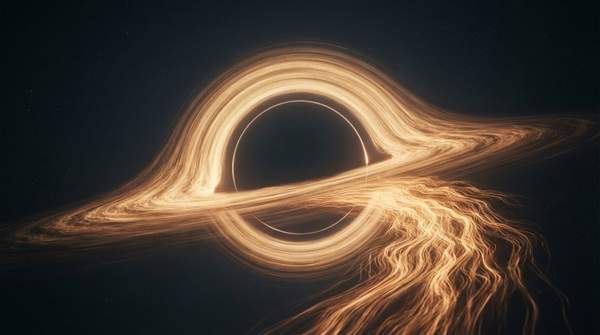
Astronomers classify black holes into four main categories distinguished primarily by their mass: stellar-mass, intermediate-mass, supermassive, and the theoretical primordial black holes. According to NASA, these classifications are approximate, as scientists continually reassess the precise mass boundaries that define each group. The level of scientific certainty also varies dramatically across this spectrum, from the well-documented existence of stellar and supermassive black holes to the elusive nature of their intermediate cousins and the purely hypothetical status of primordial ones.
Stellar-Mass Black Holes: Remnants of Giant Stars
The most common type of black hole is formed from the gravitational collapse of a single, massive star. According to Priyamvada Natarajan, a theoretical astrophysicist at Yale University, this process begins when stars with a birth mass roughly eight to ten times greater than our sun exhaust their nuclear fuel. Without the outward pressure from fusion, the star's core collapses catastrophically, often triggering a supernova explosion that blasts its outer layers into space while the core implodes into a black hole. Not all stars end their lives this way; Natarajan notes that stars with lower birth masses leave behind less extreme objects like neutron stars or white dwarfs.
The U.S. National Science Foundation (NSF) states that most stellar-mass black holes are typically five to ten times more massive than the sun. However, observations from the Laser Interferometer Gravitational-Wave Observatory (LIGO) have revealed a wider range, detecting several black holes with masses up to 100 times that of the sun. These discoveries, made possible by sensing the ripples in spacetime from cosmic collisions, have expanded our understanding of the upper limits of this common black hole category.
Intermediate-Mass Black Holes: The Elusive 'Missing Link'
Positioned between the common stellar-mass black holes and the colossal supermassive ones are intermediate-mass black holes (IMBHs). These objects, with masses ranging from hundreds to hundreds of thousands of times that of the sun, have long been considered a "missing link" in the story of black hole evolution. Scientists actively hunt for them because their existence is a crucial test of theories about how black holes grow. As NASA explains, over cosmic time, collisions between stellar-mass black holes should have created some IMBHs, making their apparent scarcity a puzzle.
The formation of IMBHs is an area of active research, with several proposed mechanisms. One pathway, described by Natarajan, involves the direct collapse of vast clouds of gas in the early universe, a process that bypasses the formation of a star entirely. Another theory suggests they can form in the crowded hearts of dense star clusters. For years, numerous candidates were identified, but definitive proof remained elusive. That changed with the detection of gravitational waves from an event known as GW190521, which the NSF reports confirmed the existence of an IMBH. David Ottaway of the University of Adelaide described the finding as “a huge step towards understanding the link between the smaller black holes that have been seen by gravitational-wave detectors and the massive black holes that are found in the centre of galaxies.”