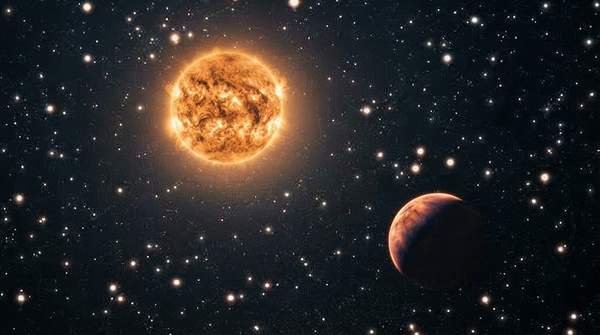
Astronomers have traced a mysterious radio signal that pulses every eight minutes to a white dwarf orbiting a star much like our Sun—the first time such a system has been found with a Sun-like companion rather than a red dwarf. The discovery, published in Nature Astronomy on November 15, 2026, by researchers at Curtin University's node of the International Centre for Radio Astronomy Research (ICRAR) in Perth, expands the known parameters of a newly defined class of cosmic objects called long-period transients.
A New Cosmic Enigma: GPM J071507−114153 Discovered
The system, designated GPM J071507−114153, sits more than 5,000 light-years from Earth and consists of two stars orbiting each other: a dead star—a white dwarf, the leftover core from a star's death—that spins every eight minutes, and a G-type star similar to our own Sun. The Murchison Widefield Array (MWA) in Australia first detected the pulsating signal in late 2024, and between December 2024 and September 2025 it recorded 214 pulses from the source, leading astronomers to classify it as a long-period transient.
What sets this detection apart is its clarity. After roughly 100 hours of processing radio data, the team achieved an observational first. "This is the first time the pulses are clear enough to see the white dwarf moving in its orbit around its companion," said Sam McSweeney, the study's lead author and an astronomer at Curtin University. "[S]o we know that the pulsations are coming from a region close to the white dwarf, or possibly even from the white dwarf itself."