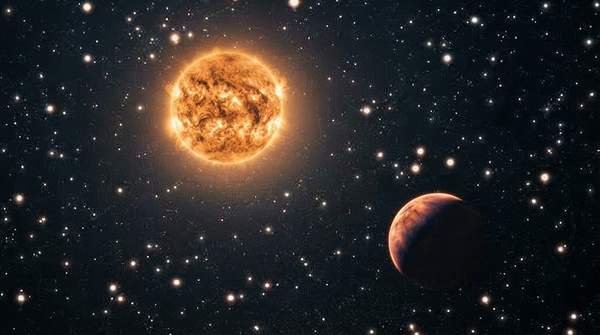
The James Webb Space Telescope's Mid-Infrared Instrument, or MIRI, sees something no other instrument on the observatory can: the infrared glow of a planet's own heat. Working across the 5–28 micron mid-infrared range, MIRI combines imaging, coronagraphy, and low- and medium-resolution spectroscopy to measure exoplanet temperatures and probe their atmospheres. Its power is not hypothetical. An international team used MIRI to measure the dayside of the rocky exoplanet TRAPPIST-1 b at roughly 500 kelvins—about 230°C—marking the first detection of light emitted by an exoplanet as small and as cool as the rocky planets of our own solar system.
The Mid-Infrared Advantage: Why MIRI Sees What Others Can't
Most exoplanet characterization relies on the near-infrared instruments on Webb, which probe shorter wavelengths where stars shine brightly but where a planet's own thermal output is faint. MIRI occupies a different regime. Its 5–28 micron band, described in the European Space Agency's technical documentation as imaging, coronagraphy, and integral field spectroscopy over that range, is precisely where cooler objects—temperate planets, dust, and planet-forming material—radiate the bulk of their energy. A planet at a few hundred kelvins does not visibly shine; it glows in the mid-infrared.
That capability converts MIRI from a camera into a thermometer. By measuring how much infrared light a planet emits, astronomers can infer its temperature, and that temperature, in turn, carries diagnostic weight. A world that is significantly hotter than expected for its distance from its star may be shedding heat poorly, implying a thick atmosphere redistributing energy; a world matching bare-rock predictions suggests little or no atmosphere. A review of exoplanet atmosphere exploration notes that JWST is proving transformative for characterizing directly imaged exoplanet atmospheres in the mid and thermal infrared precisely because this wavelength regime captures thermal emission that shorter-wavelength instruments cannot.
MIRI's Specialized Observing Modes for Exoplanets
The instrument's versatility comes from a deliberately broad suite of modes. According to the JWST User Documentation maintained by the Space Telescope Science Institute, MIRI offers four observing capabilities: imaging with nine photometric bands, coronagraphic imaging with four different filters, low-resolution spectroscopy in slit or slitless configuration, and medium-resolution spectroscopy with four integral field units. Each mode answers a different scientific question, and choosing among them is the first decision an observer makes.