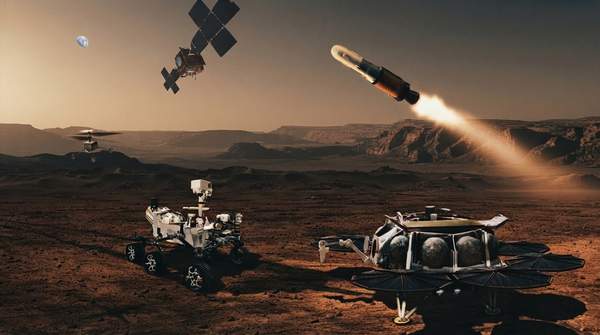
The Mars Sample Return mission is, at its core, a solution to a stubborn problem: the most sophisticated instruments humanity can build are too large, too power-hungry and too delicate to send to Mars, so the mission proposes to bring Mars to them. Conceived as an international campaign led by NASA with European participation, it would ferry material gathered on the Martian surface through a chain of flight segments—surface operations, Mars ascent, Mars-Earth transfer, and Earth re-entry and landing—so that laboratories on Earth can interrogate it directly. Understanding why each link in that chain exists requires understanding the science it serves.
Why Mars Samples Matter: Driving Scientific Questions
The scientific case rests on questions that robotic instruments can only partially address. NASA frames the mission around understanding how geologic, climatic and other processes have shaped Mars and its environment over time—and how those processes interact today. A returned sample, examined with the full arsenal of terrestrial instrumentation, offers a depth of analysis no landed payload can match.
A collection of papers on the scientific value of Mars Sample Return elaborates the priorities. Analyses of a modern atmospheric sample—particularly its noble gases—could clarify the origin and evolution of the Martian atmosphere, while ancient atmosphere trapped within rocks could further constrain that evolution. Returned samples would also inform future human exploration by characterizing hazards and resources, including issues bearing on crew health, vehicle design and planetary protection. Paleomagnetic measurements on oriented rock samples could constrain the planet's magnetism and the thermal evolution of its interior, according to the same body of work.