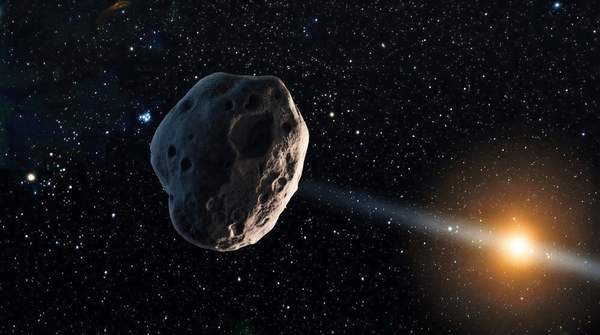
Earth occasionally gains a second moon, but never keeps it. When a small asteroid drifts close enough to cross the boundary where our planet's gravity outweighs the Sun's pull, it can become gravitationally bound to Earth for a period of months, tracing a wide, looping path around us before the combined tugs of Earth, the Moon, and the Sun fling it back into an orbit around the Sun. The latest such visitor, the roughly one-meter object 2026 QQ8, entered Earth's neighborhood in late April and is expected to escape in December, according to reporting by Passant Rabie at Gizmodo. Understanding why these captures are always temporary, and why scientists actively hunt for such objects, reveals one of the more underappreciated dynamics of our cosmic address.
What Are Earth's Mini-Moons?
A mini-moon is a small near-Earth asteroid that has been temporarily captured by Earth's gravity, making it a brief natural satellite of our planet rather than a permanent one. The defining structure is what astronomers call the Hill sphere: the region around Earth where an object can remain gravitationally bound to our planet despite the Sun's influence. Outside that boundary, the Sun's gravity governs an asteroid's path; inside it, Earth can hold the object in orbit—at least for a while.
The qualification matters, because residence in the Hill sphere does not guarantee a stable orbit. The evidence of 2026 QQ8 illustrates the pattern: the object passed near Earth in 1965 without being captured, because it never crossed into the Hill sphere, and it is expected to make another close approach in 2058 that will again fall short of capture. Only when the asteroid actually crossed the boundary in April did it become temporarily gravitationally bound to Earth. That word "temporarily" is not a hedge but a structural feature of the dynamics, as the lifecycle of these objects makes clear.
The Mini-Moon Lifecycle: A Four-Phase Journey
The clearest way to understand a mini-moon is as a sequence: an asteroid arrives from solar orbit, is captured, orbits Earth unstably, and is ejected back into solar orbit. Each phase is defined by the object's position relative to the Hill sphere and by which gravitational forces dominate at that moment.
| Phase | What happens | Gravitational condition |
|---|---|---|
| 1. Approach | An asteroid on a heliocentric orbit passes through the inner solar system near Earth. | The Sun's gravity still dominates; the object remains unbound. |
| 2. Capture | The asteroid crosses into Earth's Hill sphere and becomes gravitationally bound to our planet. | Earth's gravity outweighs the Sun's influence within this region. |
| 3. Unstable orbit | The object follows a strange, wide, looping path around Earth, typically lasting months. | The orbit is highly unstable, shaped by competing pulls. |
| 4. Escape | The object slips out of Earth's gravitational grasp and resumes its journey around the Sun. | Perturbations from Earth, the Moon, and the Sun combine to eject it. |
The third phase is where the temporary nature of the arrangement becomes visible. 2026 QQ8, for instance, forms a wide, kidney-shaped loop around Earth, approaching no closer than about 0.0038 astronomical units—roughly one and a half times the distance between Earth and the Moon—before escaping. A study of temporarily captured objects summarized in reference material on Earth's claimed moons found that such objects remain in orbit for ten months on average before returning to solar orbit, a finding further examined in research published in the journal Icarus. These are not the tidy ellipses of the permanent Moon; they are paths shaped by a continuous tug-of-war.
The escape is the inevitable end of that contest. Research on temporary satellite capture in planetary systems by Agnor and Hamilton and colleagues, examining capture dynamics across the planets, found that the overall percentage of temporary captures that do not escape is small. In other words, the gravitational card game that admits an asteroid into Earth's orbit almost always, eventually, deals it back out. That is why astronomers describe these objects as visitors rather than moons in the ordinary sense: capture is a phase, not a state.