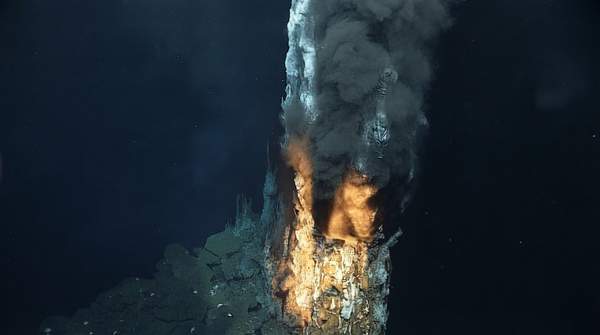
Black smokers, white smokers, and cold seeps are three chemically distinct deep-sea environments, and the fastest way to tell them apart is to look at three things: where they sit geologically, how hot their fluids are, and what color and composition their plumes carry. Black smokers erupt superheated, sulfur- and metal-rich water from tall chimneys at volcanic mid-ocean ridges. White smokers emit cooler, lighter-colored fluids rich in barium, calcium, and silicon from smaller chimneys. Cold seeps, by contrast, release hydrocarbon-rich fluid at roughly ambient seawater temperature through sediments along continental margins, with no volcanism involved at all.
Introduction to Deep-Sea Chemosynthetic Environments
What unites these three habitats is more remarkable than what divides them. None of them depends on sunlight. Instead, all three host ecosystems built on chemosynthesis, in which bacteria derive energy from the chemicals dissolved in the emerging fluids, such as sulfides at vents and methane and related compounds at seeps. These microbes form the base of a food web that supports dense animal communities on an otherwise sparsely populated seafloor.
The differences among the three environments flow from their plumbing. As NOAA Ocean Exploration explains, cold seeps are relatively stable, long-lived places where hydrocarbon-rich fluid seeps up from cracks in the seafloor, while hydrothermal vents are volatile, short-lived openings created through volcanism, where magma-heated, high-temperature water emerges. That single contrast—slow, steady seepage versus violent, episodic eruption—shapes everything from fluid chemistry to the size and lifespan of the structures themselves.
Geological Formation: Vents vs. Seeps
Hydrothermal vents, the category that includes both black and white smokers, exist only where volcanism reaches the seafloor. According to the Geosciences LibreTexts oceanography text, vents form where there is volcanic activity on or below the ocean floor, such as along the Mid-Ocean Ridge. Seawater percolates down through cracks in the seafloor, is heated by hot rock deep within the ocean crust to as much as 400°C, and then erupts back upward as mineral-laden "smoky fountains."
The immense pressure of the deep ocean prevents this superheated water from boiling, as National Geographic's education resource notes: at 400°C (750°F), the seawater simply cannot boil because the pressure is too great. As the hot fluid meets cold ambient seawater—around 2°C in the deep sea, per NOAA's measurements at a Marianas vent—the dissolved minerals it carries precipitate out of solution, building the rocky chimneys that make vents so visually striking.
Cold seeps follow an entirely different script. MarineBio describes their settings: they form along continental margins where organic matter buried in sediments produces methane, above underground hydrocarbon reservoirs, and at sites where methane hydrates—ice-like structures that trap methane—destabilize and release their gas. No magma is required. The fluids migrate slowly through sediment layers, which is why seeps persist far longer than the volatile, short-lived vents.
Black Smokers: High Heat and Iron Sulfides
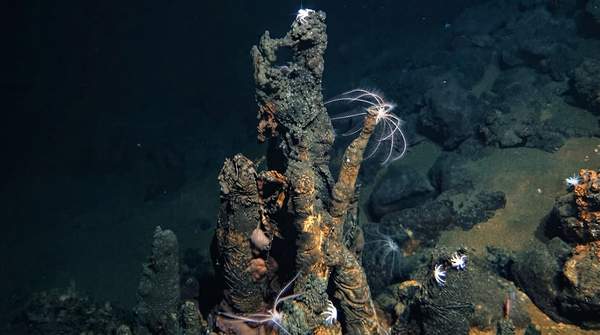
Black smokers are the extreme end of the hydrothermal spectrum. National Geographic characterizes them as emitting the hottest, darkest plumes, which are high in sulfur content, and forming chimneys up to 18 stories tall—55 meters, or 180 feet. The LibreTexts account adds that the hottest vents produce these unusual chimney-like towers, and that the emerging water carries dissolved metals including iron, manganese, zinc, copper, and sulfur.
The signature black color is a precipitation effect. When the sulfur-rich, metal-laden fluid hits near-freezing seawater, iron sulfides and other minerals precipitate as fine dark particles, giving the plume the appearance of billowing black smoke. NOAA Ocean Exploration documented this directly during its 2016 Deepwater Exploration of the Marianas, measuring vent fluid at 339°C at a black smoker where super-hot fluid met 2°C ambient seawater and minerals precipitated out of solution to form the chimney structure.
These chimneys grow as minerals solidify around the vent orifice, and they can grow rapidly. But the vents themselves are geologically fleeting: the volcanic systems that feed them shift, and individual smokers can shut down or die within years to decades, making them among the most ephemeral large structures on the planet.
White Smokers: Cooler Fluids and Lighter Minerals
White smokers arise in the same volcanic settings as their darker cousins, but under conditions that yield cooler, chemically different emissions. National Geographic's comparison is direct: the plumes of white smokers are lightly colored and rich in barium, calcium, and silicon, and compared to black smokers, white smokers usually emit cooler plumes and form smaller chimneys.
The lighter color reflects a different mineral suite precipitating from the fluid—barium, calcium, and silicon compounds rather than the dark iron sulfides that dominate black smoker plumes. Because the fluids are cooler, they carry a different dissolved load and precipitate different minerals on contact with seawater, which is why the two smoker types can coexist within the same vent field yet look nothing alike.
National Geographic also notes that vents with even cooler, weaker flows are often called seeps, and that these appear to shimmer because of temperature differences in the water or bubble because of dissolved gases like carbon dioxide. This points to a genuine continuum: as hydrothermal activity wanes, a hot black smoker can transition through cooler, weaker-flow stages before the system quiets entirely.
Cold Seeps: Hydrocarbon-Rich and Ambient Temperatures
Cold seeps sit at the quiet end of that continuum, though most form through sedimentary rather than volcanic processes. Their fluids emerge at roughly the same temperature as the surrounding seawater, as both NOAA and MarineBio emphasize. What they lack in heat, they make up for in chemistry: the seeping fluid is rich in hydrocarbons, particularly methane, whether generated by organic matter decomposing in continental-margin sediments, leaking from underground reservoirs, or released from destabilizing methane hydrates.
That stability matters biologically. Because seeps are long-lived relative to vents, their communities have more time to establish, grow, and reach large sizes—NOAA's comparison of seeps and vents highlights that organism growth rates differ between the two settings, with the stable seep environment favoring slower, longer-lived communities. The visible signs of a cold seep are subtle: shimmering water where fluid and seawater differ slightly in temperature or salinity, gas bubbles rising from the sediment, and pale bacterial mats spreading across the seafloor.
Comparative Overview of Deep-Sea Chemosynthetic Environments
The table below synthesizes the defining attributes of all three environments into a single classification framework. To use it, work from observable characteristics—geological setting, fluid temperature, plume appearance, and dominant life—toward an identification, since each column's traits cluster together as a consequence of the underlying geology.
| Characteristic | Black Smoker | White Smoker | Cold Seep |
|---|---|---|---|
| Formation / Geology | Volcanic settings such as mid-ocean ridges; seawater percolates into the crust and is superheated by hot rock | Similar volcanic settings, but conditions yield cooler emissions | Continental margins, above hydrocarbon reservoirs, or where methane hydrates destabilize; slow fluid migration through sediments, no volcanism |
| Fluid Temperature | Hottest vent fluids; measured at 339°C at one Marianas vent, and can reach up to 400°C | Cooler than black smokers | Roughly the same temperature as surrounding seawater |
| Chemical Composition | High in sulfur; dissolved metals including iron, manganese, zinc, and copper; iron sulfides precipitate as black particles | Rich in barium, calcium, and silicon, giving plumes a light color | Hydrocarbon-rich, particularly methane; may carry gases such as carbon dioxide |
| Physical Structure | Tall chimneys up to 55 meters (180 feet), built by precipitating minerals | Smaller chimneys than black smokers | No chimneys; shimmering or bubbling seepage through cracks and sediments |
| Stability / Lifespan | Volatile and short-lived | Part of the same volatile vent systems | Relatively stable and long-lived |
| Ecosystem Basis and Typical Organisms | Chemosynthetic bacteria sustained by sulfide-rich fluids | Chemosynthetic communities sustained by cooler mineral-rich fluids | Chemosynthetic bacterial mats, symbiont-bearing tubeworms, mussels, and clams |
Life in the Deep: Chemosynthetic Ecosystems
The biological story ties these physically disparate habitats together. MarineBio notes that cold seep communities include many of the same types of organisms found at vents: chemosynthetic bacterial mats, symbiont-bearing tubeworms, mussels, and clams. In both settings, the animals themselves do not eat the vent or seep fluids directly; they host chemosynthetic bacteria—either internally or on their surfaces—that convert the dissolved chemicals into usable organic matter.
This overlap is more than coincidence. Tubeworms, mussels, and clams appear across vent and seep environments, which points to evolutionary and ecological connections between habitats that may lie thousands of kilometers apart. The pattern makes sense given the geography: vents dot the mid-ocean ridge system while seeps line the continental margins, and the deep ocean between them offers routes for larvae and migrating fauna. The shared dependence on chemosynthetic microbes, rather than any particular temperature or mineral, is the common thread.
The differences in growth and pace remain real, though. NOAA's seep-versus-vent comparison emphasizes that the stable, long-lived seep environment supports different organism growth rates than the volatile, short-lived vent environment, where communities must colonize quickly and tolerate extreme heat and chemistry. A vent field can vanish within a human lifetime; a seep can persist for far longer.
Identifying Deep-Sea Chemosynthetic Habitats
To accurately identify and differentiate between black smokers, white smokers, and cold seeps, observe their geological setting, fluid temperature, chemical plume characteristics, and dominant biological communities. The classification framework is observable and repeatable: the presence of high-temperature, dark, sulfide-rich plumes indicates a black smoker; cooler, lighter plumes with silica, barium, and calcium suggest a white smoker; and ambient-temperature, hydrocarbon-rich seeps point to a cold seep, each supporting distinct but sometimes overlapping chemosynthetic life.
For the reader deciding what to look at first, temperature and setting do most of the diagnostic work. A towering mineral chimney on a volcanic ridge, venting fluid hot enough to melt lead, is a black smoker; a smaller, paler chimney in the same kind of field is a white smoker; and a shimmering, bubble-traced patch of sediment on a continental margin, carpeted with bacterial mats and tubeworms, is a cold seep. The next time a deep-sea expedition broadcasts footage, those three checks—setting, heat, and plume color—will place what you are watching within this spectrum of chemosynthetic habitats.
Sources
- What is the difference between cold seeps and hydrothermal vents? - NOAA Ocean Exploration
- 5.12: Vents on the Seafloor- Black Smokers, White Smokers, and Deep-Sea Vent Communities — Geosciences LibreTexts
- Deep Sea Hydrothermal Vents — Education
- "Black Smoker" - NOAA Ocean Exploration
- Hydrothermal Vents & Chemosynthetic Ecosystems — MarineBio