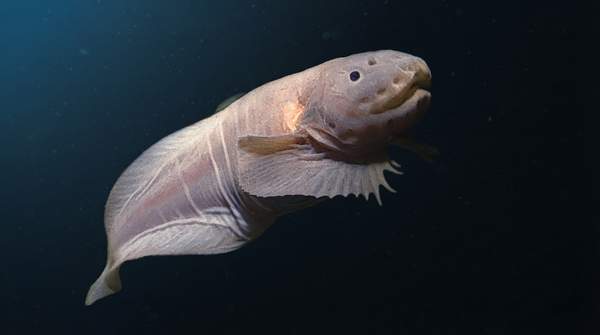
Life in the ocean's deepest trenches survives not by resisting pressure with brute strength but by adjusting to it at every biological scale. Below roughly 6,000 meters, in the hadal zone, organisms counteract extreme hydrostatic pressure through a coordinated set of solutions: molecules called piezolytes that stabilize proteins, cell membranes engineered to stay flexible, and soft, gelatinous bodies that give pressure nothing to crush. Understanding these mechanisms reveals adaptation not as a single trait but as a multi-level system.
The Crushing Reality of the Hadal Zone
The hadal zone begins around 6,000 meters below the ocean surface and includes the deepest trenches on Earth. At such depths, the weight of the water column above creates hydrostatic pressure that acts on every molecule of a living body, not just its outer surface. A submarine survives by building rigid metal walls; biology cannot. Instead, as the science publication Kori Science frames it, hadal life "does not fight pressure" — it adjusts to the ocean rather than defeating it.
Extreme pressure affects proteins, membranes, enzymes, and metabolism, according to Kori Science's overview of hadal survival strategies. A review of pressure denaturation research published through the National Center for Biotechnology Information describes pressure-induced protein unfolding as a well-known phenomenon, one that has provided researchers with unique insights into protein conformational landscapes. In other words, pressure is not merely a physical squeeze; it actively distorts the delicate three-dimensional shapes that biomolecules need to function. That distortion is the fundamental problem every hadal organism must solve.