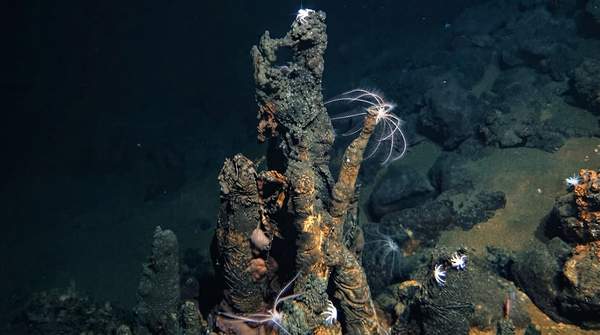
When scientists descended toward an oceanic spreading ridge near the Galapagos Islands in 1977, they were searching for geology and found biology instead. The hot springs they discovered on the seafloor—hydrothermal vents—were surrounded, as the National Oceanic and Atmospheric Administration recounts, by large numbers of organisms never before seen. The deeper lesson was more startling still: in total darkness, thousands of meters below the surface, life had found a second way to make a living. Rather than drawing energy from sunlight, these communities run on chemical energy released by the planet itself. Bacteria convert toxic, mineral-rich vent fluid into food, and everything else in the ecosystem builds on that foundation.
The Geological Origins of Deep-Sea Hydrothermal Vents
Every vent begins with plate tectonics. According to NOAA, underwater volcanoes at spreading ridges and convergent plate boundaries produce these hot springs, and the communities around them depend on chemical processes that result from the interaction of seawater with hot magma. That interaction is the engine of the entire system, and it runs in a continuous loop rather than a one-time event.
The cycle starts when cold seawater percolates down through cracks in the ocean crust near zones of tectonic activity—spreading centers where plates pull apart, or convergent boundaries where they collide. As the water sinks, magma deep below heats it dramatically. In the process, the hot fluid dissolves minerals and metals from the surrounding rock. The Woods Hole Oceanographic Institution describes the result as heated, mineral-rich water escaping from Earth's crust through seafloor openings—fluids loaded with chemicals such as hydrogen sulfide, along with metals like copper and zinc.
Heated, pressurized water is buoyant, so it rises back out of the crust and gushes into the deep ocean. When it emerges, it is chemically very different from the seawater around it. Woods Hole Oceanographic Institution notes that because vents transport minerals and other chemicals from the ocean floor into circulating seawater, they play a critical role in Earth's geochemical cycles. For the purposes of the vent ecosystem, the crucial point is simpler: what arrives at the seafloor is a cocktail of energy-rich dissolved chemicals that no sunlight-powered system ever uses.
This is also what distinguishes hydrothermal vents from cold seeps, another chemosynthesis-based deep-sea habitat. While cold seeps release hydrocarbons slowly at ambient temperatures, hydrothermal vents are defined by hot fluid actively circulated through volcanic crust—geology supplying both the heat and the chemicals.
Chemosynthesis: Life's Chemical Fuel in the Deep Sea
I find chemosynthesis most intuitive when placed side by side with photosynthesis. NOAA's Ocean Exploration service puts the distinction plainly: photosynthesis and chemosynthesis are both processes by which organisms produce food, but photosynthesis is powered by sunlight while chemosynthesis runs on chemical energy. Most life on the planet sits in a food chain that revolves around the sun. In the deep ocean there is no light, and so no plants; chemical energy takes the primary role instead.
The work is done by microbes. At vent sites, bacteria obtain energy from the oxidation of inorganic substances carried up in vent fluid—most famously hydrogen sulfide (H2S), the compound that gives rotten eggs their smell and that is toxic to most animals in high concentrations. To the bacteria, it is fuel. As the educational resource CK-12 explains, one general equation for sulfide-based chemosynthesis is 12H2S + 6CO2 → C6H12O6 + 6H2O + 12S: the bacteria oxidize hydrogen sulfide to produce sulfur, water, and energy, and then use that energy to convert carbon dioxide into organic compounds such as glucose. In effect, they eat rock chemistry and exhale the raw material of sugar.
Not every microbe runs the same reaction. Woods Hole Oceanographic Institution reports that deep-sea microbes near vents thrive by using diverse chemical reactions—both with and without oxygen—to extract energy and grow underground, sustained by energy-rich fluids created by reactions below the seafloor. The conceptual point holds across all these variations: energy that originates in the planet's interior, rather than in the sun, is converted into organic matter. That organic matter becomes the base of a food web.
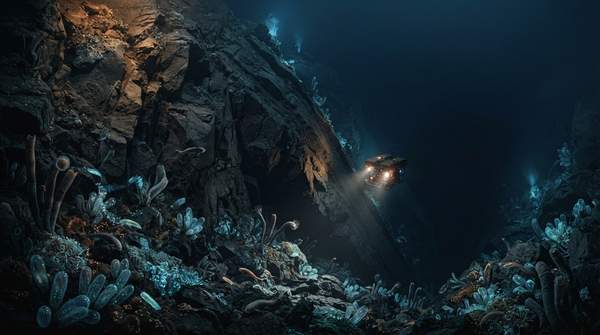
The consequence is vivid. NOAA describes places with chemosynthetic organisms as "oases of life in an environment often otherwise depleted of food." The deep ocean floor is, in general, sparse. A vent is the exception—a crowded island of abundance in the dark.
An Ecosystem Forged in Extremes: Vent Communities and Adaptations
The animals that gather at these oases are as unusual as the conditions. Hydrothermal vents impose extreme physico-chemical stresses—high pressure, elevated temperatures, low pH, and high concentrations of toxic heavy metals and hydrogen sulfide, as a review of vent biology published through the National Center for Biotechnology Information details. The organisms that live there tolerate combinations that would kill almost anything from the surface world.
The most celebrated adaptation is symbiosis. When biologist Colleen Cavanaugh was still a graduate student, she proposed that bacteria oxidizing sulfides were the mechanism by which giant tube worms could survive near vents, and she later confirmed the idea—work for which she is generally credited with the discovery of chemosynthesis at these sites. Tube worms harbor chemosynthetic bacteria inside their bodies: the worms deliver hydrogen sulfide and oxygen from the vent fluid to their internal bacterial partners, and the bacteria return organic nutrients. The worm, remarkably, has no need to eat in the conventional sense at all.
Beyond tubeworms, vent fields host shrimp, crabs, and fish, all supported by the bacterial base of the food web. According to National Geographic's education resource, bacteria provide energy and nutrients to vent species without any need for sunlight, enabling animals to survive crushing pressures, extreme temperatures, and toxic mineral plumes. These are not merely visitors; whole communities depend on the chemistry.
What makes each community scientifically precious is its isolation. Woods Hole Oceanographic Institution notes that an individual vent field is only about the size of a soccer pitch, and fields can be separated by as much as 1,000 kilometers—yet the animal communities at individual fields can form ecosystems found nowhere else in the ocean. New fields are colonized when tiny free-swimming larvae ride the currents and settle where they encounter the right vent conditions. Each vent is thus a natural experiment: unique, bounded, and biologically self-contained.
The Hydrothermal Vent Ecosystem: An Energy Flow Model
The clearest way to understand a vent is to follow energy and matter through the system, stage by stage—from the planet's interior to the animals at the top of the food web. The model below traces that pathway explicitly.
| Stage | Process | What happens | Output to next stage |
|---|---|---|---|
| 1. Geological formation | Seawater circulation through volcanic crust | Cold seawater percolates into cracked crust near spreading ridges or convergent boundaries; magma heats it, and it leaches minerals and metals from rock. | Hot, mineral-rich fluid—carrying hydrogen sulfide and other chemicals—emerges through seafloor openings. |
| 2. Chemical energy production | Chemosynthesis by bacteria | Microbes oxidize inorganic compounds such as hydrogen sulfide (e.g., 12H2S + 6CO2 → C6H12O6 + 6H2O + 12S), using the released energy to build organic matter from carbon dioxide—no light required. | Organic compounds (food) plus elemental sulfur, in place of the plant matter that anchors sunlit food webs. |
| 3. Primary consumers and symbiosis | Bacteria feeding hosts from within | Tubeworms and similar animals host chemosynthetic bacteria internally, trading shelter and vent chemicals for nutrients—a mechanism Colleen Cavanaugh proposed and confirmed. | Animals that never need to eat conventionally, converting bacterial output into growth and reproduction. |
| 4. Established community | Diverse vent ecosystem | Shrimp, crabs, and fish join the community around fluid vents, forming dense oases in an otherwise food-poor deep ocean. | A self-sustaining, locally unique ecosystem—each soccer-pitch-sized field potentially unlike any other in the ocean. |
Reading down the table, you can see why vents function as complete ecosystems: each stage consumes the output of the one before it. Geological heat and chemistry feed bacteria; bacteria feed animals directly or through symbiosis; the community persists in total darkness. The model also shows the system's fragility—every stage depends on the vent fluid itself, which means the entire food web traces back, ultimately, to magma.
Understanding Life's Resilience: Key Takeaways from Hydrothermal Vents
The decision this evidence asks of the reader is a shift in perspective: recognize that life can thrive in extreme environments without sunlight, powered instead by chemical energy from the planet's interior. Vents proved that a food web needs an energy source, not the sun specifically—a finding that, as National Geographic notes, continues to redefine our understanding of the requirements for life.
It is equally important to respect the boundaries of what has been shown. Each vent field hosts communities found nowhere else, some separated by a thousand kilometers of empty seafloor, all resting on bacteria that turn toxic chemistry into food. And the science is far from finished: the measurable indicator of continued progress in this field is the discovery of new deep-sea vent sites or novel chemosynthetic organisms. Each new site or microbe is another test of the chemosynthetic model—and, so far, the oases of the dark keep confirming it.
Sources
- What is a hydrothermal vent? — Oceanservice
- Hydrothermal Vents — Woods Hole Oceanographic Institution
- Hydrothermal vents — Woods Hole Oceanographic Institution
- What is the difference between photosynthesis and chemosynthesis? - NOAA Ocean Exploration
- CK12
- The Biological Deep Sea Hydrothermal Vent as a Model to Study Carbon Dioxide Capturing Enzymes - PMC
- Deep Sea Hydrothermal Vents — Education