The search for life beyond Earth hinges on our ability to detect biosignatures—subtle chemical clues in the atmospheres of distant exoplanets. But identifying these signs is not as simple as pointing a powerful telescope at a planet and finding a single telltale gas. The process is fraught with immense difficulty, requiring scientists to overcome a cascade of distinct physical, analytical, and chemical hurdles. A potential sign of life must survive a gauntlet of verification where the signal is first captured from across light-years, then correctly interpreted from confounding data, and finally proven to be the product of biology rather than geology.
The Three Pillars of Exoplanet Biosignature Detection Challenges
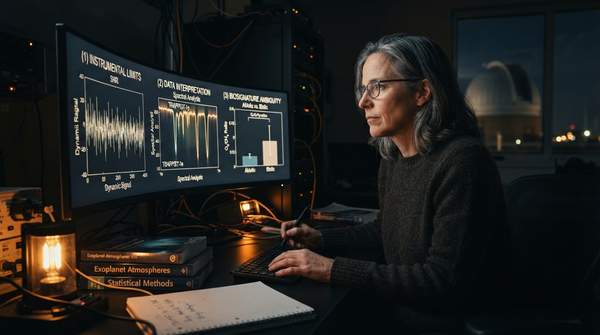
Successfully identifying a biosignature requires overcoming three sequential and formidable categories of challenges. A failure at any stage can lead to a dead end or, worse, a false positive. These pillars represent the journey from collecting faint photons of light to making a credible claim of detecting life.
1. Instrumental and Observational Challenges
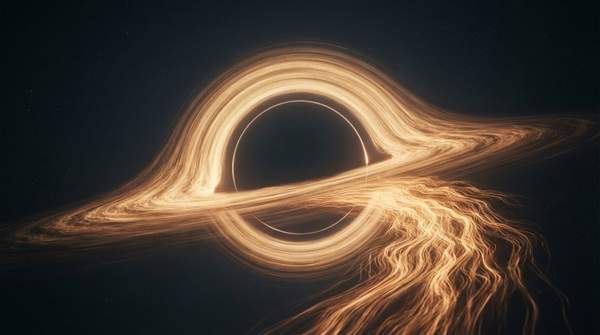
The first and most fundamental barrier is the physical act of observation. Scientists are trying to analyze the chemical makeup of a thin layer of atmosphere around a small, rocky planet that is trillions of miles away and almost completely overwhelmed by the light of its parent star. This results in extremely weak atmospheric signals and a low signal-to-noise ratio, which a review in the Journal of Young Physicists identifies as a primary barrier to progress. The challenge is compounded by physical obstructions like clouds and haze, which can render an atmosphere's spectrum featureless, obscuring any potential chemical fingerprints within it.
Current techniques like High-Resolution Spectroscopy are designed to resolve faint molecular features, but they are still constrained by the physical limits of telescope aperture, detector sensitivity, and the sheer amount of observation time required. Overcoming these issues is a constant battle of technological innovation aimed at gathering higher quality data from these incredibly faint and distant targets.
2. Data Interpretation and Modeling Challenges
Even with a clear signal, the next hurdle is interpretation. Scientists use complex computer models to analyze the light spectrum and determine which gases are present in an exoplanet's atmosphere. However, these models are only as good as the assumptions they are built on. An article on Astrobiology.com warns that in low signal-to-noise situations, apparent detections of trace gases can be "artifacts of incomplete modeling rather than robust identification."
This means a computer could identify a gas that isn't actually there simply because the model being used doesn't account for other, more complex atmospheric possibilities. The article illustrates this with the case of exoplanet K2-18 b, where a claimed detection of a potential biosignature vanished when the analytical model space was expanded. Alternative models, without the biosignature gas, were found to provide an equivalent or even better fit to the observational data. This highlights a critical vulnerability: a "detection" can depend entirely on the choice of models being compared, and a preference for one model does not necessarily prove the presence of a specific gas.
3. Biosignature Validation and Chemical Ambiguity
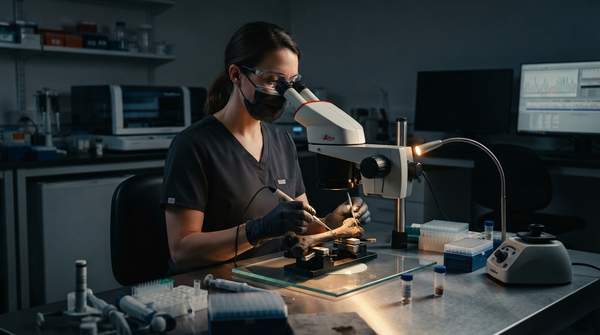
The final and perhaps most profound challenge is proving a biological origin. Even if a gas is detected with high confidence, it does not automatically mean life is present. As one review on exoplanet biosignatures explains, a substance can be a "biosignature gas" even if it also has nonbiological sources. The ultimate task for scientists is to test and, if possible, prove that the gas came from life by ruling out every other plausible explanation.
This involves a deep understanding of planetary chemistry and geology. A gas that seems out of place could be the result of unknown volcanic processes, reactions with minerals on the planet's surface, or photochemical reactions in the upper atmosphere. Every potential non-biological, or abiotic, pathway must be considered and eliminated before a biological cause can be confidently asserted. This makes the final step one of intense scientific debate and scrutiny, moving from detection to definitive attribution.