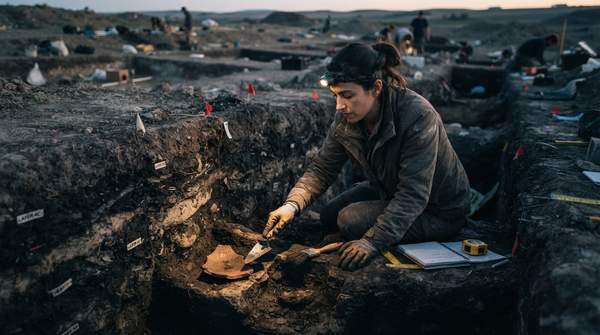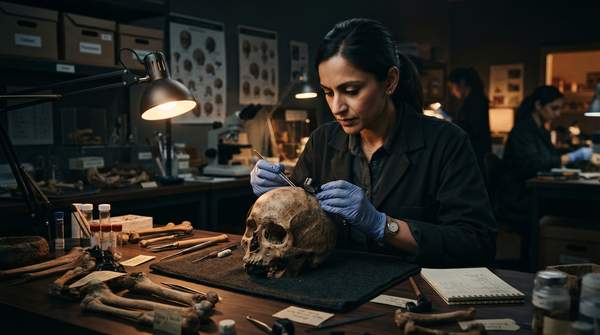
When archaeologists lift the lid on an ancient coffin, the first question is rarely "who was this?" but "how many people are in here, and when did each of them die?" Reused graves, collective burials and disturbed tombs can hold the remains of several individuals separated by centuries. Answering that question requires a toolkit of three core methods—osteological examination, isotope analysis and ancient DNA testing—each of which answers a different question about a person's life. I want to walk you through how these techniques work together, and how they untangled a real puzzle: a Roman sarcophagus at Westminster Abbey that medieval monks apparently recycled for a second occupant.
Unraveling Ancient Identities: The Bioarchaeological Toolkit
No single test identifies an ancient individual. Instead, researchers build a biographical profile layer by layer, and the order matters. The skeleton itself is read first, because it establishes how many people are present and what each of them was like in life. Chemical and genetic analyses follow, each chosen to answer a specific question the bones alone cannot settle: where someone grew up, what they ate, or when they died.
The logic is genuinely diagnostic. A question about diet points toward carbon and nitrogen isotope analysis of bone collagen. A question about childhood origin points toward strontium isotope analysis of tooth enamel. A question about time of death points toward radiocarbon dating. The Scottish Archaeological Research Framework notes that isotope signatures in preserved hard tissues—bone, tooth enamel and dentine—can reveal dietary habits and the environment a person inhabited during life, and in exceptional cases even soft tissues like hair can be sampled. The framework for combining these tools is what turns scattered bones into individual life histories.
Osteological Analysis: The First Clues from Bone
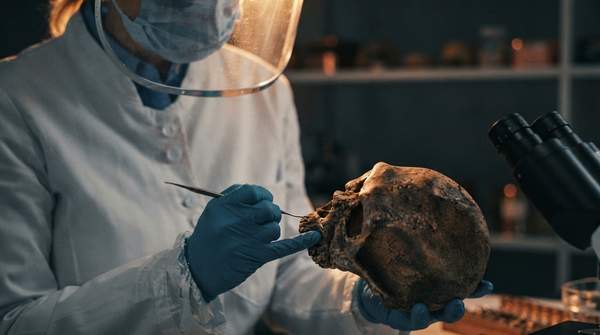
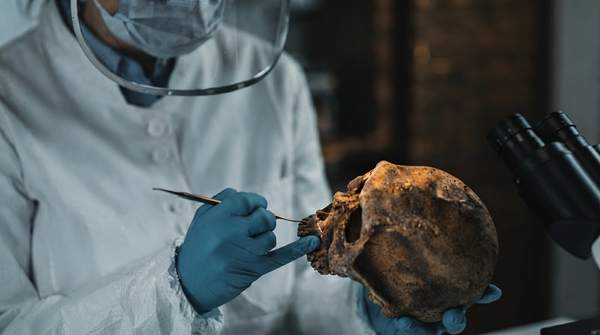
Osteological examination is the foundation of every investigation, and it starts with the most basic inventory: counting who is present. Forensic anthropologists, as a review of isotope applications in forensic anthropology explains, provide information on sex, age-at-death, ancestry and stature, along with evidence of anomalies, antemortem trauma, medical intervention and pathological conditions. That biological profile narrows the field of possible identities before any laboratory chemistry begins.
In commingled assemblages—where multiple individuals' bones are mixed together—this counting step becomes technically demanding. Conventional inventory methods, such as the Standards for Data Collection from Human Skeletal Remains, document the presence and completeness of skeletal portions and establish the minimum number of individuals, or MNI, represented by each bone portion. A methodological study from East Carolina University observes that this traditional approach is rather subjective and offers limited transparency for future researchers, which is why newer techniques adapted from zooarchaeological zonation methods record specific anatomical features rather than general completeness. The MNI is the crucial first number: it tells you whether you are studying one person or five.
Isotope Analysis: Tracing Diet and Geographic Origins
Isotope analysis works because different tissues record different chapters of a life, and the distinction between bone and tooth enamel is the heart of the method. Tooth enamel forms in childhood and, unlike bone, is never remodeled during life. As the Scottish Archaeological Research Framework explains, its densely packed crystalline structure also resists chemical change in the burial environment, making it preferential for analysis. The isotopic composition of enamel therefore reflects environment and diet during dental formation—meaning an enamel sample is effectively a childhood photograph of where a person lived and what they ate.
Bone tells the later story. Because bone continually remodels, it acquires the chemical signature of the region where a person was living in the final years of life. Strontium is the key element for tracing movement: plants and water carry varying ratios of two strontium isotopes depending on local geology, and strontium is absorbed into tooth enamel and bone through food and water, as the Crow Canyon Archaeological Center describes. Comparing measured strontium ratios in a sample against published isotope maps, the forensic anthropology review notes, allows researchers to reconstruct an individual's potential travel history. A mismatch between childhood enamel and adult bone is the classic signature of a migrant.
Diet is read through carbon and nitrogen isotopes in bone collagen, which reflect the average diet over roughly the last five to ten years of life and can distinguish marine from terrestrial food sources. Crow Canyon gives a concrete example: carbon isotope ratios in human bone have been used in the American Southwest to estimate the relative contributions of domesticated corn and wild plants to ancient diets, showing that people of the Four Corners area became dependent on corn by about 500 B.C. Carbon and nitrogen studies can also track dietary change through time, in both individuals and whole populations.
Ancient DNA (aDNA) Analysis: Genetic Signatures of the Past
Where osteology and isotopes describe a body, DNA identifies a lineage. Genetic evidence can be used for personal identification, for establishing genetic relationships between individuals buried together, and for understanding ancestry. The forensic anthropology review places DNA profiling alongside dentition and radiographs among the more in-depth scientific evaluations that usually achieve personal identification once the biological profile has narrowed the possibilities.
Ancient DNA has real limits, and they are worth stating plainly. A guide for victim service providers from the Office for Victims of Crime emphasizes that while DNA testing methods are very reliable, results can be inconclusive when the quantity of evidence is insufficient or when the evidence has been contaminated or improperly preserved—conditions that ancient, waterlogged or handled remains often meet. The same guide notes that the technology is increasing in sophistication, meaning samples that yield nothing today may be testable in the future. That prospect alone is a reason museums retain rather than consume fragile material.
The Challenge of Reused Burials: The Westminster Abbey Sarcophagus Case Study
Reused and commingled burials compress these challenges into a single container. A new archaeological study, reported by Matthew Phelan, determined that a fourth-century Roman-era coffin buried at Westminster Abbey—rediscovered in 1869—was recycled by monks during the medieval era. The occupant's identity has remained a mystery to the present day, and the case illustrates the central difficulty of reuse: the container dates to one period while the remains inside may date to another, so coffin style and body cannot be assumed to belong together.
Commingled assemblages pose special challenges, but they are not merely an obstacle. As one guide to studying commingled and disarticulated remains puts it, since commingling is both a natural and a cultural process, it should be viewed "not strictly as an impediment to study... but as a kind of 'life history' of a skeletal assemblage." The same source cautions that methodology has to be adapted and traditional bioarchaeological conclusions are often limited. A companion volume on commingled, disarticulated and disturbed burials notes that such remains appear in many contexts—prehistoric collections, mass graves, mass disasters and poorly curated museum assemblages—and that accurate interpretation depends heavily on preservation and completeness. In a reused sarcophagus, the practical response is to date the remains themselves, individually, rather than trusting the grave goods.
Archaeological Investigation: A Decision Framework
The clearest way to see how these methods cooperate is to map each archaeological question to the test that answers it. The framework below traces the investigative path from an initial discovery to a full biographical profile: each row shows a question the remains raise, the material that must be sampled, the method that fits, and what it reveals. Follow the rows in order and you are walking the actual sequence of a bioarchaeological investigation.
| Archaeological question | Material analyzed | Method | Information revealed |
|---|---|---|---|
| How many individuals are present? | All skeletal elements | Osteological inventory and MNI calculation | Minimum number of individuals; biological profiles of sex, age-at-death, ancestry, stature, trauma and pathology |
| When did this person die? | Bone collagen or enamel | Radiocarbon (carbon-14) dating | Approximate time of death—essential for separating original occupants from later interments, as with the Westminster Abbey sarcophagus |
| Where did this person grow up? | Tooth enamel (formed in childhood, never remodeled) | Strontium isotope analysis | Childhood geographic origin; comparison with isotope maps identifies locals and possible immigrants |
| Where did this person live as an adult? | Bone (continually remodeled) | Strontium isotope analysis | Region of residence in the last several years of life; enamel–bone mismatch indicates adult mobility |
| What did this person eat? | Bone collagen | Carbon and nitrogen isotope analysis | Average diet over the last 5–10 years of life; marine versus terrestrial foods, crop dependence |
| Who was this person related to? | Bone or teeth | Ancient DNA analysis | Genetic ancestry and relationships between individuals; may be inconclusive if samples are contaminated or too degraded |
Notice how the framework resolves the reused-grave problem in principle. Radiocarbon dating establishes which bones belong to which era; osteology ensures each era's bones are counted and profiled correctly; isotopes and DNA then attach a life story to each dated individual rather than to the coffin that happens to hold them. The specific sequence and combination of methods always depend on the questions being asked and on how well the remains are preserved.
Reconstructing Lives: The Ongoing Quest for Identity
The decision for any investigator facing a complex or reused burial is to employ a multi-faceted scientific approach, integrating osteological, isotopic and genetic analyses, to accurately identify individuals and reconstruct their life histories, particularly in challenging contexts. No single method suffices: bone counts without dating cannot separate occupants, and dating without osteology cannot tell one skeleton from two.
The measurable indicator of success is the successful identification of individuals in challenging commingled or reused burials, evidenced by published research that integrates multiple scientific methodologies to provide a comprehensive biographical profile. The Westminster Abbey study is exactly this kind of milestone—a reused Roman sarcophagus whose medieval recycling was established through scientific dating rather than assumption. For readers following the field, each new study of this kind, and each future retest of DNA samples that today yield inconclusive results, extends what we can know about the people inside the world's oldest coffins.
Sources
- Someone Reused This Roman Sarcophagus. We May Finally Know Who’s Inside — Gizmodo
- 2.4 Isotope Analysis | The Scottish Archaeological Research Framework — SCARF
- Recent applications of isotope analysis to forensic anthropology - PMC
- Paleoanthropology
- Comparing Methodologies for Documenting Commingled and Fragmentary Human Remains — Thescholarship
- Stable Isotope Analysis - Crow Canyon Archaeological Center — Crow Canyon Archaeological Center -
- Understanding DNA Evidence: A Guide for Victim Service Providers — OVC